A journey through radical Govanhill
Explore Govanhill’s rich history of activism, from protests and political organising to major community campaigns and victories. This guide from Radical Glasgow Tours highlights key sites across the neighbourhood, uncovering the stories of resistance and collective action that have shaped one of Glasgow’s most politically active communities.
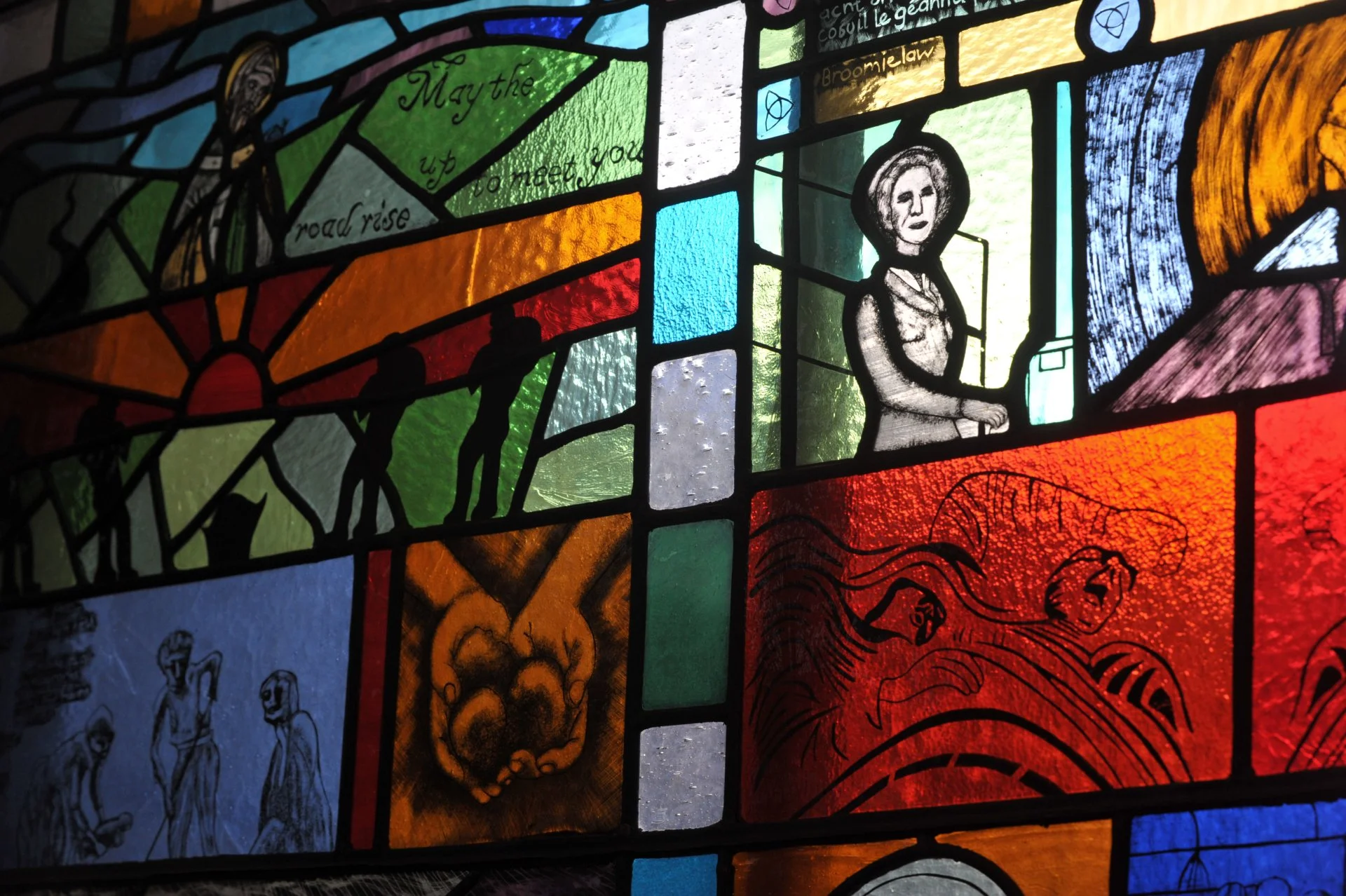
Govanhill Library stained glass windows – photo by Iain Mclellan
By Katherine McKinnon
You don’t have to walk far in Govanhill before finding yourself at a spot where members of the community have organised, fought for their rights and celebrated their wins. This neighbourhood has long been a focus in the city for demonstrations, political speeches, organising and community action. Take a walk through some of these histories with Radical Glasgow Tours using this guide.
If this has piqued your interest and you want to learn more, check out upcoming tours on radicaltoursglasgow.com to go on a guided walk of the area.
Queen’s Park: Top of Victoria Road
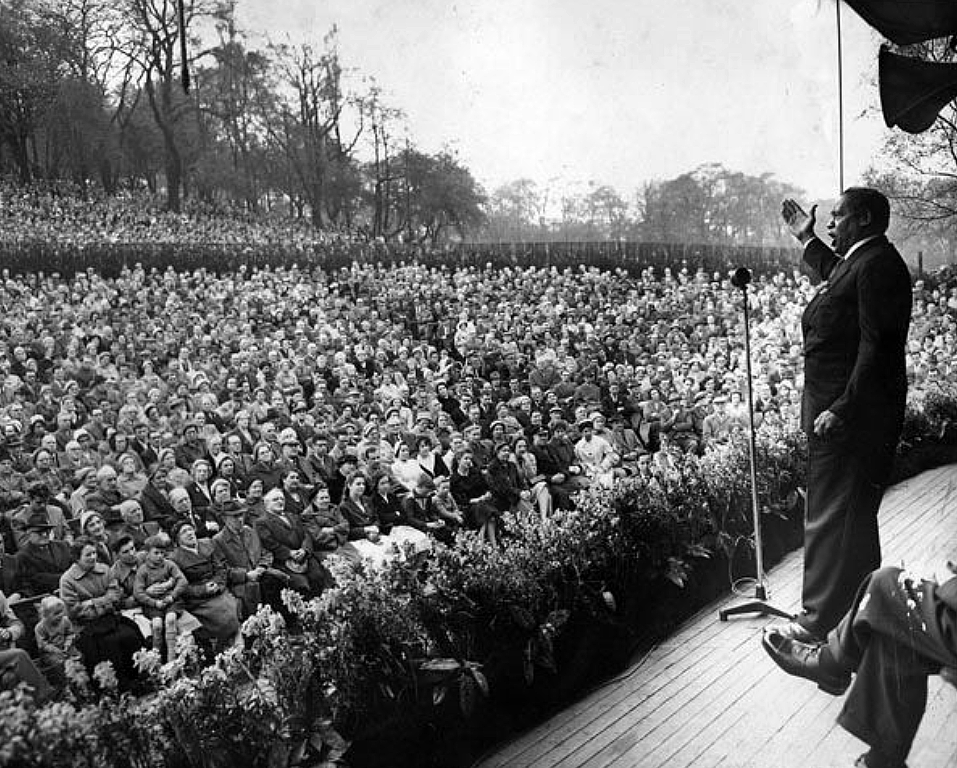
Paul Robeson speaking in Queen’s Park | Photo from STUC
Start at Queen’s Park. Standing on the bandstand stage, picture the crowds that packed the stands in years past. In 1960, thousands of trade unionists listened to the American labour leader, singer and film star Paul Robeson speak from this stage. He told the crowd “There can be no question that we, the people, in the deepest sense, create the wealth. We are building a world in which we can live a rich and decent life, and we and our children should enjoy it.”
Robeson was an active anti-fascist. In 1936, the British Union of Fascists tried to hold a meeting at the gates of Queen’s Park. This was a popular spot for political speakers, mostly from the city’s many socialist, anarchist and communist groups. Although they only had about a hundred members in the city, the British Union of Fascists had the support of powerful aristocrats. They were beaten back by young people from the Jewish Workers’ Organisation, the Young Communist League and the Labour League of Youth. Anti-fascists disrupted proceedings by singing loudly to drown out the speeches or sometimes taking more direct action by knocking speakers off the tables they stood on. This physical act of resistance is the origin of the term ‘no-platforming’.
From the gates look down Victoria Road, which has always been the heart of the working-class, migrant community. Every year the Govanhill carnival comes this way. Taking up public space with loud, joyous, defiant displays of community solidarity is more vital now than ever.
2. Govanhill Baths: 126 Calder Street
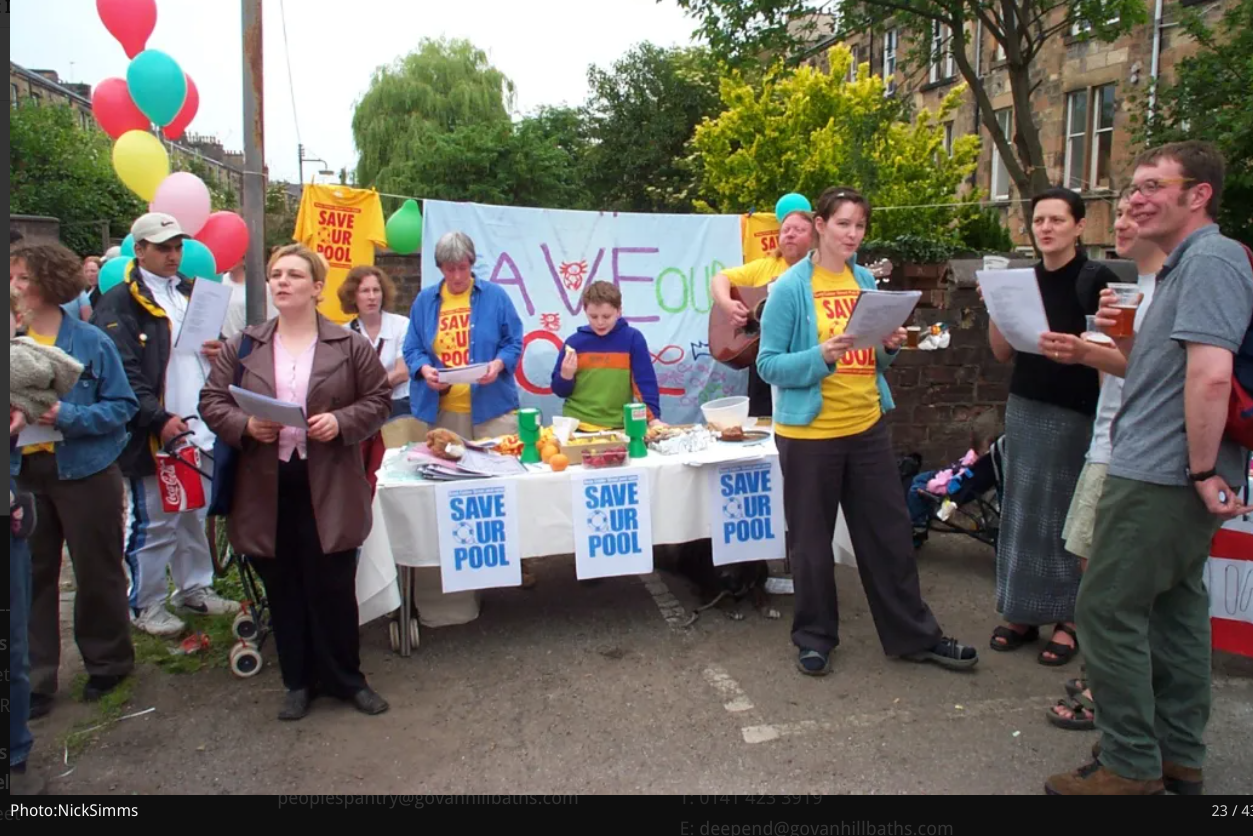
Govanhill Baths protest | Photo by Nick Sims
Head down Victoria Road, turning right into Calder Street until you reach the Govanhill Baths. The Baths were opened in 1914 and generations of local people learned to swim here. As well as swimming there were also washing facilities and a bathhouse. The Baths served the people of Govanhill well until 2001, when the council threatened to close it down. The local community immediately sprang into action and the Save our Pool campaign was born. A dozen people broke into the closed building and chained themselves to the cubicles, leading one of the longest occupations of a public building in British history.
Govanhill Baths is part of a larger history of occupations of contested spaces in the city, from workers occupying factories to people protesting the construction of motorways through city parks. Nearby in Kenmure Street in 2021, the local community packed the street and surrounded an immigration van to prevent the removal of two neighbours, reminding us that direct action does in fact get the goods.
3. Govanhill Library windows: 170 Langside Road
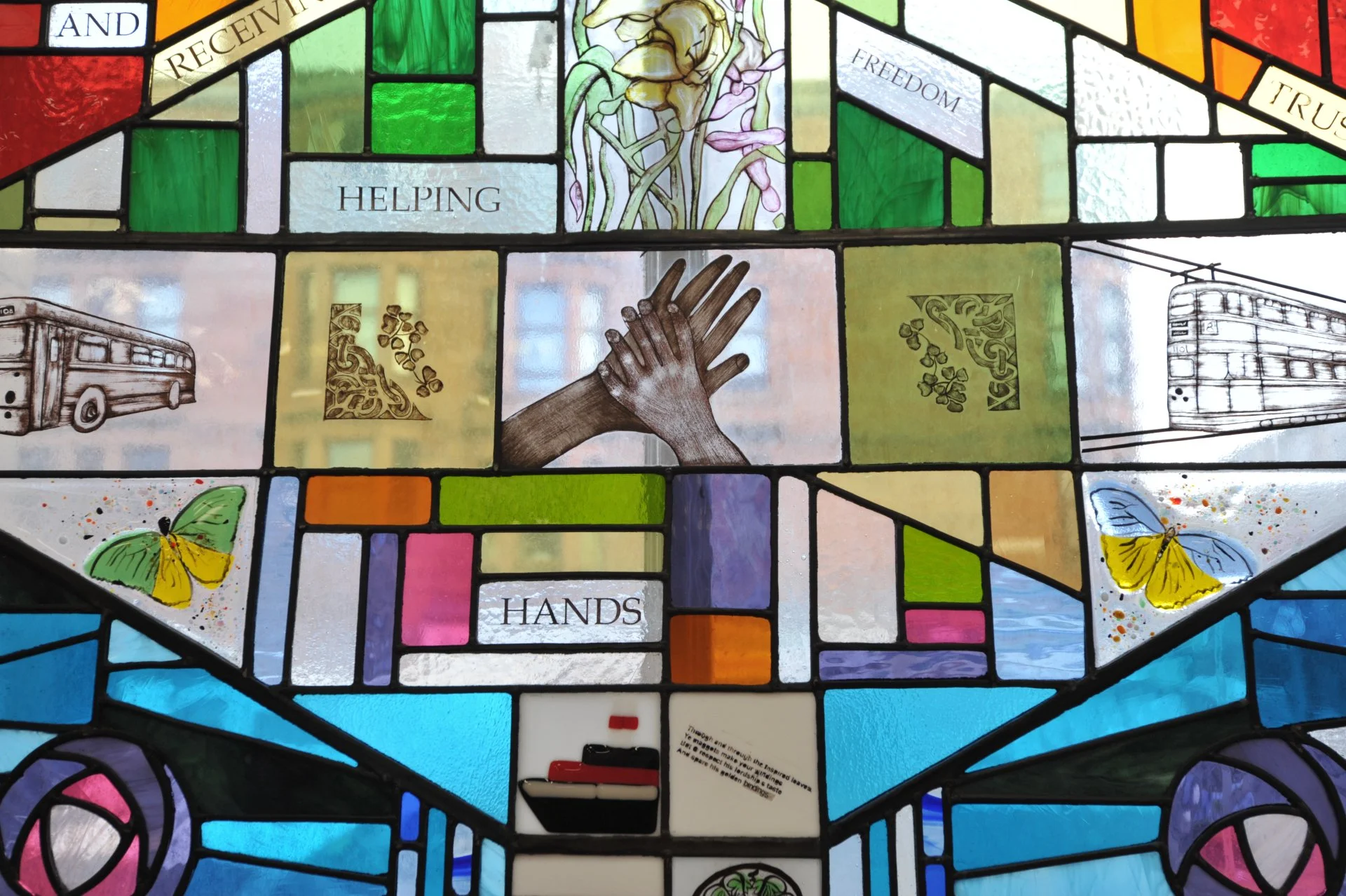
Govanhill Library windows – photo by Iain McLellan
Continue down Calder Street towards the library. Step inside to check out the windows – each panel documents different people’s histories of the neighbourhood; showing images and text representing youth culture, sari textile patterns, Irish migration and more. These panels are part of a larger series across Glasgow Libraries celebrating working class culture and history, by stained glass artist Keira McLean.
Nearby, on South Annandale Street, Govanhill Open Museum’s ‘Welcome to Govanhill’ mural also celebrates the rich cultural and linguistic heritage of the area. Each letter of Govanhill contains a pattern from a fabric or object shared by people in the community – how many do you recognise?
4. St Bride’s Primary: 83 Craigie Street
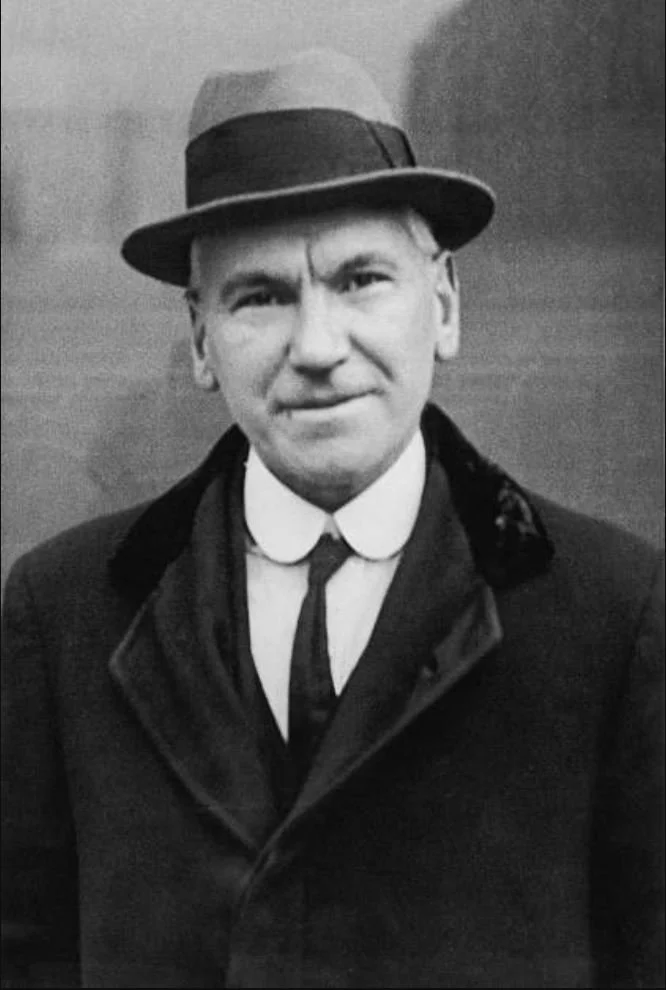
John Maclean
From the library head down Langside Road, then turn right onto Allison Street, cross Victoria Road then turn left onto Craigie Street to face St Bride’s. On a school day you will hear children shouting and singing, just as you would have done when John Maclean worked here. Maclean was a young radical in his first teaching job, where he quickly made enemies with the head teacher. As well as filling his spare time campaigning for Britain’s first Marxist political party, The Social Democratic Federation, he formed the Scottish Association of Socialist Teachers and campaigned against homework and corporal punishment.
He was fired from what was then Strathbungo Public School and later forced out of the profession altogether for his communist teachings and anti-war activity. After his first arrest he was taken to the former police station here on Craigie Street (now flats), and this would lead eventually to Maclean being tried for sedition and sentenced to hard labour in Peterhead jail. He was celebrated by Lenin and Trotsky, while MI5 considered him the most dangerous man in Britain.
There was also huge community action here in 1979, when 600 anti-fascists gathered outside the building to counter a talk by Scotland’s single National Front candidate – to his 15 supporters.
Too many struggles of the past continue into the present day and people in the neighbourhood continue to organise – for tenants’ rights and better housing, against fascism, to make Govanhill an apartheid free zone, to build community and remind ourselves that together we are strong. Look to the past to learn from and be inspired by rebels and revolutionaries long gone, but remember the old trade union motto: ‘the past we inherit, the future we build.’