Culture shift: How do we build communities of care?
One writer goes on an exploration of why shifting focus from theory to community power reveals that civil rights and social justice movements are rooted in building networks of care.
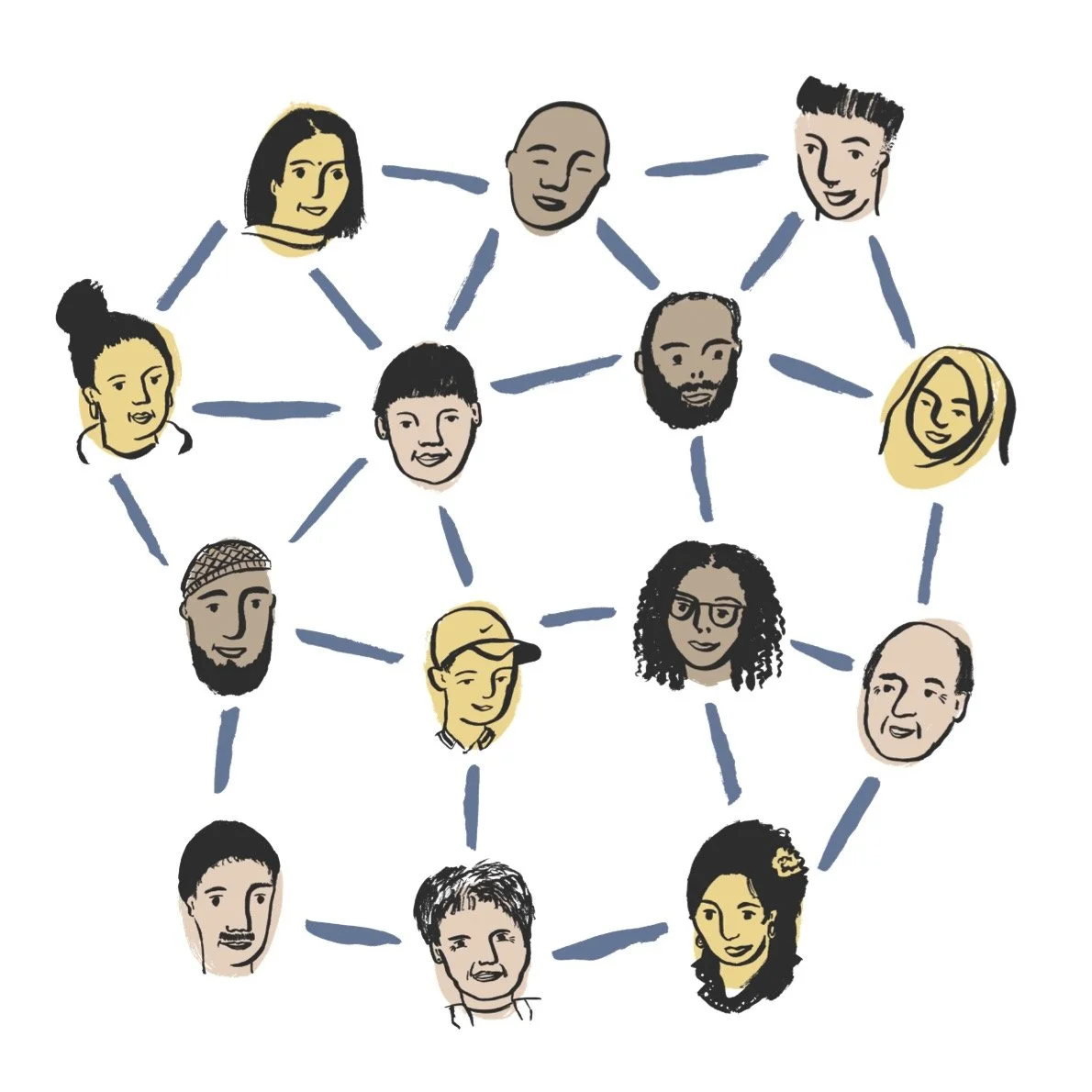
By Natalia Uribe | Illustration by Stuart White
For a long time, I believed that good proactive policy could tackle social inequalities like housing, the energy crisis and food poverty around the world. After entering the political and policy sphere, I realised that the focus was never on proactivity or prevention. In fact, the focus was reactionary and on cost-reduction, and this hasn't changed. I recognised the system didn’t value lived experience, hopefulness, or what I would consider commonsense long-term solutions. Unfortunately, in our capitalist society, there is no room for spending that which doesn’t make money. The focus was just on quick fixes to save money.
That's when I decided to shift my focus. Instead, I tuned into the concept of community power.
Rather than focusing on traditional academic theories, politics or philosophy, I turned my attention to movement building, particularly around civil rights and social justice. Through this, I found countless groups and movements sharing a common thread; they’re cultivating communities of care.
The origins of ‘community of care’
If you try googling this very question, you will find results centred around health or the care system, which in this context is similar. This concept grew out of a model aiming to move away from institutional care and refocus on personal dignity, autonomy and inclusion. This was due to a refocus on resources and approach in the NHS and the introduction of the Community Care Act 1990.
Community can be defined as a place where solidarity can be found and participation utilised to cultivate change. A safe community is a place where we’re able to reflect on our past beliefs and ask ourselves whether these beliefs still support our current values and needs. It’s a place to land softly during waves of tragic news and an armoury that helps build resilience together.
‘Care’ is often a term relating to the care system, or a feeling of concern or interest – also providing or looking after something or someone. Just the act of caring is a form of resisting a system that moulds us to be individualistic. Showing up and caring for your neighbour is a radical act of community care. Engaging in difficult conversations within your circle is another form of resistance and an act of care for everyone.
Could this be the antidote to far right populism? YES.
The hard truth about populism is that it affects those on either side of the spectrum, whether you are left or right. At its heart, populism feeds on an ‘us vs them’ mentality. This framing oversimplifies complex issues and fosters division, defining certain groups as outsiders or enemies. Those boundaries are rarely fixed – they shift depending on who’s speaking and what political goals they’re pursuing. Having said that, far right populism often tends to focus on more exclusionary forms, deeply rooted in racism, homophobia and misogyny.
Meanwhile, in its 2025 Global Risks Report, the World Economic Forum ranked societal polarisation as the 4th most significant global risk in the short term. If we deem this as a sickness, then surely there must be an antidote? Something that injects concepts of personal dignity, autonomy and inclusion. Luckily, it’s something you can get for free and probably closer than your local pharmacist.
The Southside, with its reputation as one of the most community-focused areas of Glasgow, is a living example of this. Especially in Govanhill, this multicultural neighbourhood has come together to advocate for representation of all through community projects, cultural activities, an anti-racist festival and locally produced opportunities. There is an intention and a desire to create a sense of belonging that is needed when cultivating a community of care that bridges multiple cultures, languages and identities.
That is how you tackle far-right populism, by challenging the individualistic mentality and prioritising care and community.
Let’s reflect and connect!
During the civil rights movement in the US, Black activists led different movements, whether by Martin Luther King Jr. or Malcolm X. However, there was an even bigger coalition across racial groups that included the Chicano Movement led by Cesar Chavez and Dolores Huerta. This led to the recognition that our communities need to form collective radical acts of care to tackle racial rhetoric, police brutality and loss of rights.
The phrase tu lucha es mi lucha (meaning your struggle is my struggle) highlights that the fight for equality and a better way of life is a collective struggle that we can only tackle through collaboration and unity.
Fast forward to something closer to home. The Kenmure Street protest against the detention of two residents is one of the most recent, well-known examples of Scottish unity and a community in action. In 2021, community lines were crossed to engage in the protection of their neighbours. This shows how collective resistance and care can be used as a tool for amplifying community voices and strengthening the power of the people. It’s solidarity like this that can stop oppression by unjust systems.
Not every community of care needs to be massive, sometimes it’s the tight-knit groups that can send shockwaves into a system. The Glasgow Girls is one of my favourite pieces of modern local history to share. Seven young school girls bonded together to force the public to recognise the poor treatment of asylum seekers who were marginalised, ignored and rights exhausted through appeals. Together they planned radical acts of care to campaign against dawn raids, raise public awareness and challenge the system in order to change it.
Caring for the collective doesn’t just create change locally – it transcends borders, shining a spotlight on injustices wherever they are experienced. So how can you prevent the pull of right wing populism and social polarisation?
You invite, you engage, you care. It is so important to not only have the difficult discussions with those we trust, but also those that we struggle to fully understand or relate to. The elites who hold the power only divide and redirect blame. Don’t let it happen to your community.