Factored Out: How Glasgow’s Property Management Industry Fails Us
Factors in Glasgow should be trusted agents and custodians; however, for many of us, they are more a source of frustration, risk, and often exorbitant costs. The system around factoring is badly strained and often dogged by talk of corruption at higher levels, leaving tenants (and especially homeowners) paying the price.

By James Dixon | Illustration by Olivia Juett | Photos by Iain McLellan
I live in a locally infamous flat in Shawlands that has had shoring work up for a couple of years now, with a huge crack along its front that my family and I have recently vacated for major works to take place.
Our factor was aware of the crack from around 2016, at which time they sent a plasterer around to literally plaster over the damage and paint it to match the brickwork. When we bought the flat in 2019, it had a good home report, because as far as the surveyor was concerned, there was no crack.
Fast-forward a few years and the cracking is all over the building and three out of four external walls need to be essentially rebuilt, making it uninhabitable for the moment. Happily, we have work ongoing that will make it as good as new. However, it’s been a long process.
Initially, our factor sent a property surveyor around to conduct a scope of works, with which we were all unhappy: it turned out that the surveyor and his firm had a personal relationship with the property factor’s higher-ups. We got together and employed a third party. Disgruntled at the lack of care our factor had shown to us and our block, our neighbour became the de facto project manager, and we have got the work going on our own.
The factors of the property were approached for a comment regarding this, a spokesperson said: “We are unable to comment specifically in relation to any matters that are private in nature between ourselves and our customers. As a business however, we always endeavour to work closely with owners and where appropriate, seek their instruction in relation to the maintenance of the fabric of their building.
What is a factor?
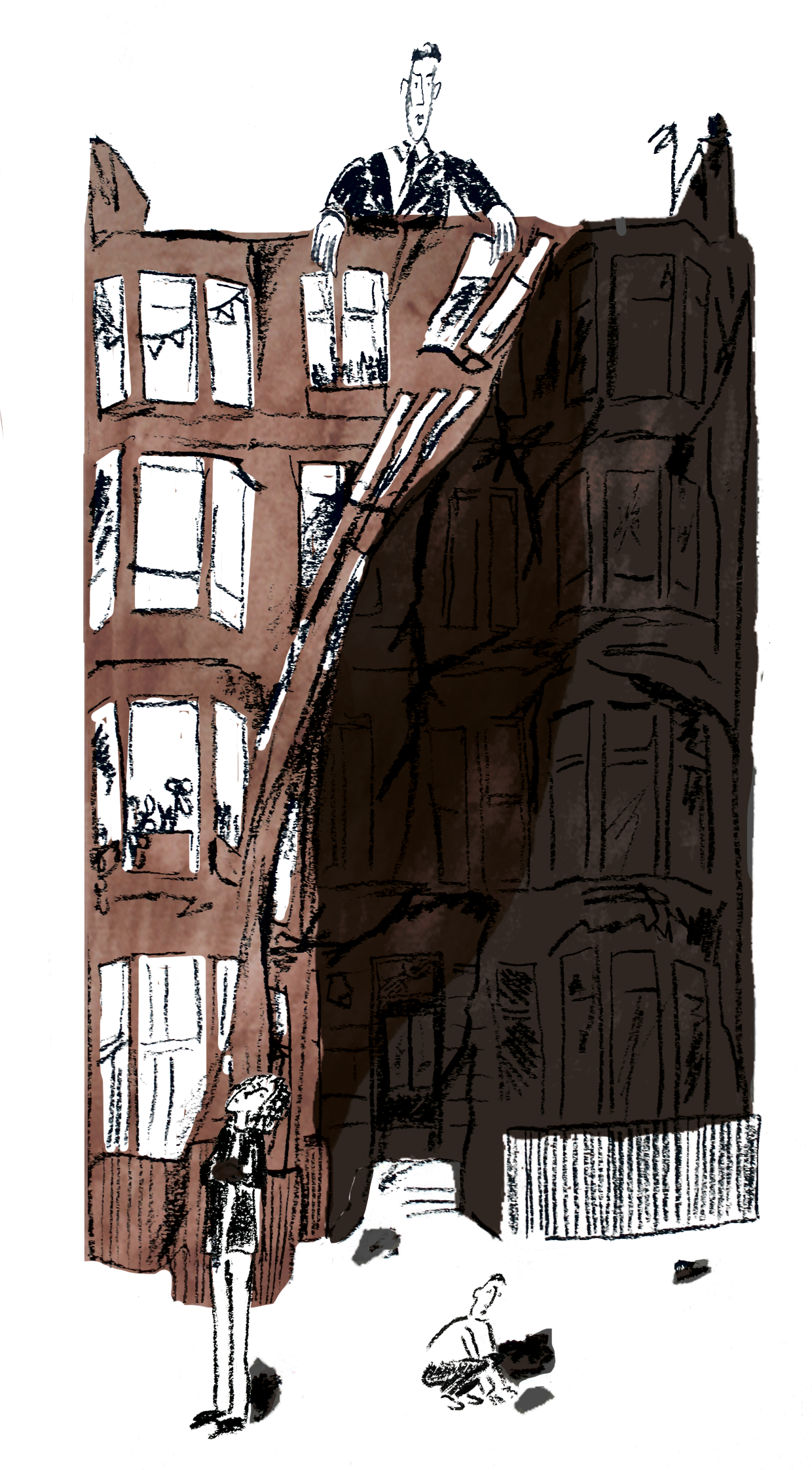
At its simplest, a property factor is a person or firm appointed by the owners, often through their title deeds, and often inherited when they buy the flat – to manage and maintain a building’s common areas: the close, the roof, the stairs, any courtyard or garden, external walls, lighting and the building’s insurance. They collect levies, monthly or quarterly, arrange repairs, manage contractors, and maintain accounts.
This role is very important in a city like Glasgow, whose sandstone tenements are part of its bones as something of a heritage landscape. Many buildings are older and repairs can be complex; owners must co-operate to keep the place in shape and to preserve that heritage architecture, which is far easier said than done without a professional body arranging things. Factoring is vital for these buildings on so many levels. We’ve seen firsthand what can happen without it; the collapse of the fire damaged tenament on Kenmure Street last year left owners in a precarious position, devastated financially and emotionally.
Legally, a factor’s role is grounded in the Property Factors (Scotland) Act of 2011, introduced in October 2012. This created the statutory register of property factors (the Scottish Property Factor Register), set out a Code of Conduct, and gave homeowners new protections. The legislation involved works alongside other laws, most notably the Tenements (Scotland) Act 2004 and the Title Conditions (Scotland) Act 2003, which govern how shared ownership works, how factors may be appointed or removed, and how major works are agreed.
Factors must register, issue a written statement of services, keep records, handle complaints, and act reasonably. However, registration doesn’t really mean all that much; it certainly does not guarantee good service.
What’s going wrong in Glasgow?
Factoring isn’t unique to Glasgow – plenty of cities in Scotland have them. But Glasgow leans more heavily on them than most, due in part to its distinctive historical and structural landscape, especially the prevalence of traditional sandstone tenements.
Major complaints from homeowners and tenants across Glasgow are common and striking: a lack of transparency, surprise bills, often erroneous, slow or ineffective action, and worse.
It’s common to hear of owners not being told of major works or not being given a breakdown of costs. Contractors appear to be appointed with minimal tendering (a process in which multiple contractors are approached to carry out work in order to get the best possible price and service). When homeowners query charges, they may be met with debt‐recovery threats rather than any kind of explanation or resolution.
My story
This is just one of many stories in a city flooded with bad stories. In fact, we all received letters from our factor claiming to be reaching out in case we felt there was any work needed – loose tiles, or anything like that. They had been walking by, apparently, and had seen that the building (which is being propped up by shoring work and is visibly crumbling) might benefit from a bit of TLC. We all laughed; it’s better than crying.
Despite the headaches many homeowners endure, factoring can at least theoretically work effectively when transparency and shared purpose are at its heart.
In Glasgow’s Southside, initiatives like Govanhill Housing Association (GHA) and Southside Housing Association (SHA) illustrate how this can look in practice. For example, SHA offers factoring services through its in-house team (registered under the Scottish Property Factor number PF001051), whilst Govanhill Housing Association is a community-controlled organisation that owns and manages social housing and private factoring in Govanhill and Merrylee, delivering housing and community development services shaped by local residents for local people
Approaches like these standout: per SHA, contractors are ‘carefully selected … only used if they meet high standards’ and periodic tenders are conducted to secure value for money. Owners receive a written Statement of Services, clear communications around planned works, and major repairs are consulted in line with the deeds. When the roof needed replacing across several blocks, the association arranged competitive quotes, informed owners in advance of budgets and timelines, and circulated comprehensive accounts after completion. That level of engagement turned what could have been a financial shock into a coordinated improvement and bought a level of trust from tenants.
Glasgow City Council either owns or manages large swathes of housing stock; their purview arguably covers all housing stock, as it’s in their interest to ensure their city has adequate, good quality housing for its residents. It is responsible for regulation and some oversight, yet it is under severe financial strain as budgets have been squeezed.
Under Glasgow City Council’s Private Sector Housing Grant (PSHG) programme, the authority provided almost £8.6 million in 2024/25 for private-home improvements across the city, funding that includes repairs and maintenance for the common areas in Glasgow’s many tenements. The Council also operates a Voluntary Common Repair Scheme for traditional tenement buildings, under which it can offer up to 50 percent grant assistance per owner, provided all owners agree to participate and meet the scheme’s criteria, including undertaking comprehensive repair works identified by survey (which is what our block is working with).
This may sound generous. However, for example, the repairs on our flat will cost up to £700k. With GCC contributing 50%, this is costing them around £350k. There is no exact number for the total number of tenement blocks in Glasgow, but according to research by the University of Glasgow’s Social Sciences Hub, it is estimated that there are at least 77,000 pre-1919 homes, which include a significant number of tenement flats. That £7.7 million looks pretty paltry: it will not go far towards maintaining housing stock across the city (they could afford to repair a mere 22 tenement blocks in the same condition as ours).
There are also quite a few relevant legal and regulatory failings. For instance, The Code of Conduct adopted under the 2011 Act requires factors to issue a written statement of services within four weeks of appointment, to provide transparent accounts, tender major works fairly, keep records, and properly handle complaints. This often doesn’t happen. I spoke to a few homeowners in the Southside about their experiences, and it’s common for factors to fail in providing statements, records, invoices, and there have been instances of Factors threatening residents with bailiffs at the least provocation.
There is no mandatory inspection regime of factor practices, and complaints may take months to resolve. As one homeowner put it on a Glasgow forum: ‘Factors are basically parasites that charge extortionate prices.’
Alternatives and possible improvements

Is there anything that can be done to salvage the situation, or at least to make the infrastructure and processes work for residents? Rather than simply directing money towards faceless organisations that often do not work to an acceptable standard?
Self-factoring is one possibility. Owners and residents essentially take on the role of managing common areas, setting up a residents’ association, agreeing budgets, tendering works, holding contractors, and keeping transparent accounts. This means more direct control, greater transparency, and potentially much lower overheads.
However, this can be a draining process, especially when things go wrong. It relies on engaged owners, time, expertise and a willingness to work together, all of which are often lacking. Many blocks can struggle to recruit volunteers or navigate complex legal frameworks.
Alternatively, there are safeguards you can put in place to make sure your factors work for you:
Checking the Property Factor Register to confirm your factor is formally registered, reading your factor’s written statement of services: it should set out what they will do, how often, costs, and how complaints are handled.
Insisting on transparency, requesting a breakdown of offers/tenders for major works, minutes of owners’ meetings, and full accounts of how levies are spent.
Lodging complaints with the factor if you suspect breaches of the Code of Conduct, and applying to the First-tier Tribunal for Scotland (Housing and Property Chamber), which has jurisdiction over complaints made under the Property Factors (Scotland) Act 2011.
Checking your title deeds for provisions on appointing or dismissing a factor (often a vote of owners is required, for example, a two-thirds majority).
Perhaps most importantly, engaging with your neighbours. Build consensus, hold meetings, agree on a budget, and consider self-management if viable.
Better policy is sorely needed. Housing charities warn that complaints about property factors are rising sharply. Rebecca Fagan of Advice Direct Scotland said her organisation handled 133 cases last year. She added: ‘These cases will be the tip of the iceberg… many flat owners rely on property factors for maintenance.’ Citizens Advice Scotland recorded a 19% rise in complaints, largely about billing and ‘excessive or unusual charges.’ Their housing spokesperson, Aoife Deery, recently said that ‘it is essential that everyone in Scotland has a safe, secure and affordable home.’ However, these figures suggest this unfortunately isn’t the case.
Glasgow and Scotland more widely should push for stronger enforcement of the Code of Conduct: periodic audits of factors, performance metrics, public disclosure of results. Local authorities should ensure they are not passing repair liabilities to owners through neglect of their own stock. Tendering of major works must be transparent, and owners must have a clear role. A larger budget should be put aside for repairs if we are to preserve our historic tenement blocks and ensure adequate housing stock.
Ultimately, homeowners in Glasgow don’t have to passively accept poor factoring. With the right knowledge, organisation and momentum, blocks can improve their management arrangements, reduce costs and safeguard value. Glasgow’s beautiful tenements deserve as much; homeowners and tenants deserve it.
