Who gets to swim: Govanhill Baths and the rise of public swimming
In part two of this three-part article, we dive into the rise of public bathhouses like Govanhill Baths and what these spaces meant for working-class and marginalised communities.
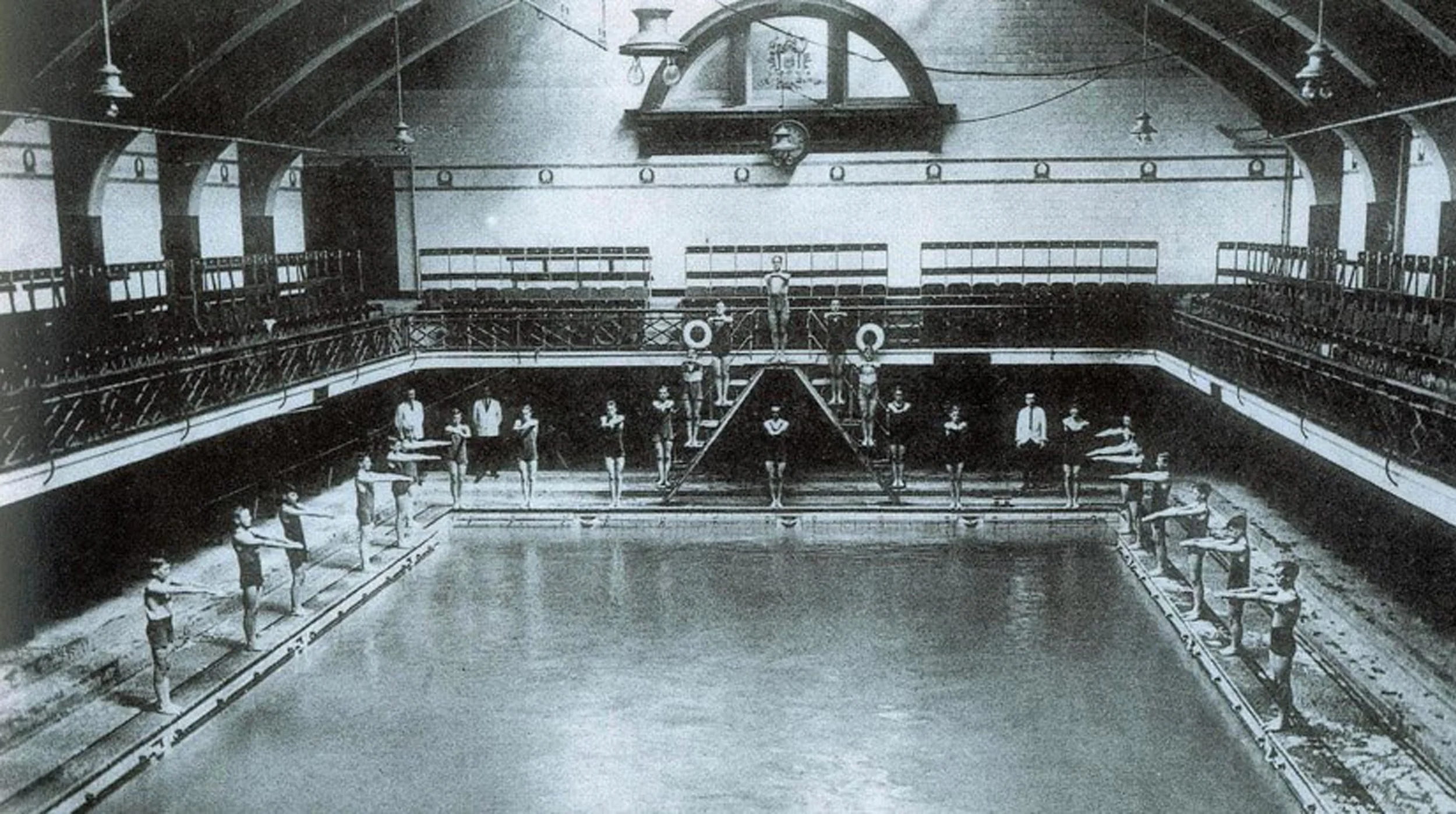
Large pool at Govanhill Baths circa 1920
By Bruce Downie | Photos by Eric Eunson
In 1860, the viaduct from Loch Katrine opened and began delivering millions of gallons of clean water to Glasgow’s residents. The first concern was to alleviate a series of cholera epidemics and improve sanitation, but as new water supply was connected to different districts of the city, new possibilities emerged, leading to the construction of three, privately-owned swimming pools.
The most prominent was St Andrew’s Swimming Baths on Greendyke Street, which opened in 1870. There was another bathhouse on Cromwell Street in Woodlands, and a third facility on London Road in the East End.
But these pools were too small for Glasgow’s wealthy businessmen who wanted a more exclusive, luxurious experience and so Arlington Baths, the first members-only swimming club opened in 1871. Four other private clubs followed over the next 10 years including The Western in Hillhead, Victoria Baths on Butterbiggins Road and one in Dennistoun and Pollokshields.
Before Arlington opened, the municipal project was already in hand. In 1869, the council had begun talking about constructing public facilities, but it would be another nine years before those plans were realised, delayed by bureaucracy and financial anxiety. That delay would prove useful, because it allowed the ardent supporters of the project to observe and learn from the private pools and from similar endeavours in England.
This ambitious project began at a time when the boundaries of Glasgow were much smaller than they are now. The chosen locations reflected the population density of the time, where the need was greatest. The first public baths opened at Greenhead in 1878, followed by North Woodside in 1882, Cranstonhill in 1883, Townhead in 1884 and Gorbals on Main Street in 1885. Those early ponds had no filtration, so operated on a ‘fill-and empty’ rota, which meant the water had to be changed every week. Obviously, the water was at its cleanest at the beginning of the week and the prices were accordingly higher. As the week progressed and the water got murkier, prices were lowered.
Bringing a pool to Govanhill
In Govanhill, a proposal to construct a swimming pool was tabled in 1909 by the local councillor, but it would be another four years before construction started in October 1913. When the Calder Street facility opened in 1917, the design still reflected the class and gender divisions of the time. There were first and second-class baths; two entrances, one for men, another for women and children. Men and women were not permitted to swim together; there were separate pools and a smaller teaching pool.
These divisions would not remain in place for long, the struggle for universal suffrage, which had reached a peak just before the war, and the economic consequences that followed that conflict, would see those divisions crumble. Soldiers on leave were given free admission to assist their recovery, schools were encouraged to teach children a vital life-saving skill, and women began to enjoy more freedom than ever before. Govanhill Baths, conceived in the Edwardian era, had to adapt to a changing world.
Social change at Calder Street
In 1922, the first swimming club to permit men and women to swim together, was the Socialist Swimming Club, who held their meetings in Calder Street. The council could not dictate what individual swimming clubs permitted. Calder Street remained the only public venue where mixed swimming was possible, until 1929.
In 1917, the forty bathtubs on the first floor were exclusively for men; one side was for first-class bathers, and the other side was for second-class bathers. Women were assigned just six baths on the ground floor, next to the teaching pool. In the 1920s, those downstairs baths were removed, and the upstairs baths were divided between men and women.
A home for amateur swimming
Many swimming clubs flocked to Govanhill when it opened in 1917, because it was the best equipped in Glasgow, with room for over 300 spectators. Over the next four decades, many important national and even international galas were held there, and the venue hosted multiple school and workplace galas, local churches even used the pond for baptisms.
One notable swimming club who made full use of the facilities at Govanhill in those early days, were the Glasgow Premier Ladies Swimming Club. Whose members included Etta Mackay, Scotland’s first world swimming champion, and Bella Moore, the first British woman to win an Olympic Gold medal in swimming.
In the 1950s, imperial competition distances were replaced by metric distances, fifty metres races became standard, so Govanhill was no longer used for major competitions. New pools, like the Royal Commonwealth Pool in Edinburgh became favoured venues for major events.
In the 1960s and 70s, the Zenith Swimming Club, trained at Govanhill, and enjoyed considerable success at a national level, until they lost the support of the council who wanted to promote their own City of Glasgow Swimming Club.
Local clubs and schools still held competitions at Calder Street, and the facilities continued to be well used by the local community. In fact, it became a vital, safe space for many local groups, who lived in or near Govanhill.
A space for the community
From the 1960s to the 1990s, on Wednesday evenings, the sauna and ladies pool were used by women only. This was an opportunity for South Asian women in particular, and also Scottish women, to enjoy an enclosed, private, culturally appropriate space, where friendships could be nurtured, domestic issues could be discussed, and joys and sorrows could be shared. The ladies pool also became a space for lesbian and bisexual women to socialise, free from male scrutiny.
The attached communal laundry wash house known as Steamie was also a largely female-only space where a sense of connection with each other could be built, and where a sense of ownership of a civic building could emerge.
Closure and legacy of the Baths
In 1997, a new, modern swimming pool was constructed at Tollcross, and then in 2000, the Avanti Centre opened in the Gorbals. The council briefly offered free transportation for people in Govanhill to travel to these new facilities, but did not consider the downgrading and impending loss of a vital, local facility.
Crucially, these new pools were characterised by large windows, letting light into the swimming area, they did not provide the degree of privacy afforded by the Edwardian-era pools, still cherished by some communities.
Despite the closure of the baths in 2001, the different spaces available on Calder Street, and the ongoing campaign to restore and reopen the baths, have helped foster the community spirit still enjoyed in Govanhill today.
