Greater Govanhill and Community Renewal Rom Romeha lose Glasgow Communities Funding
The Glasgow Communities Fund is one of the few opportunities to source vital multiyear operational funding. Greater Govanhill is one of several community organisations in the neighbourhood to lose out this year, meaning your support means more than ever.
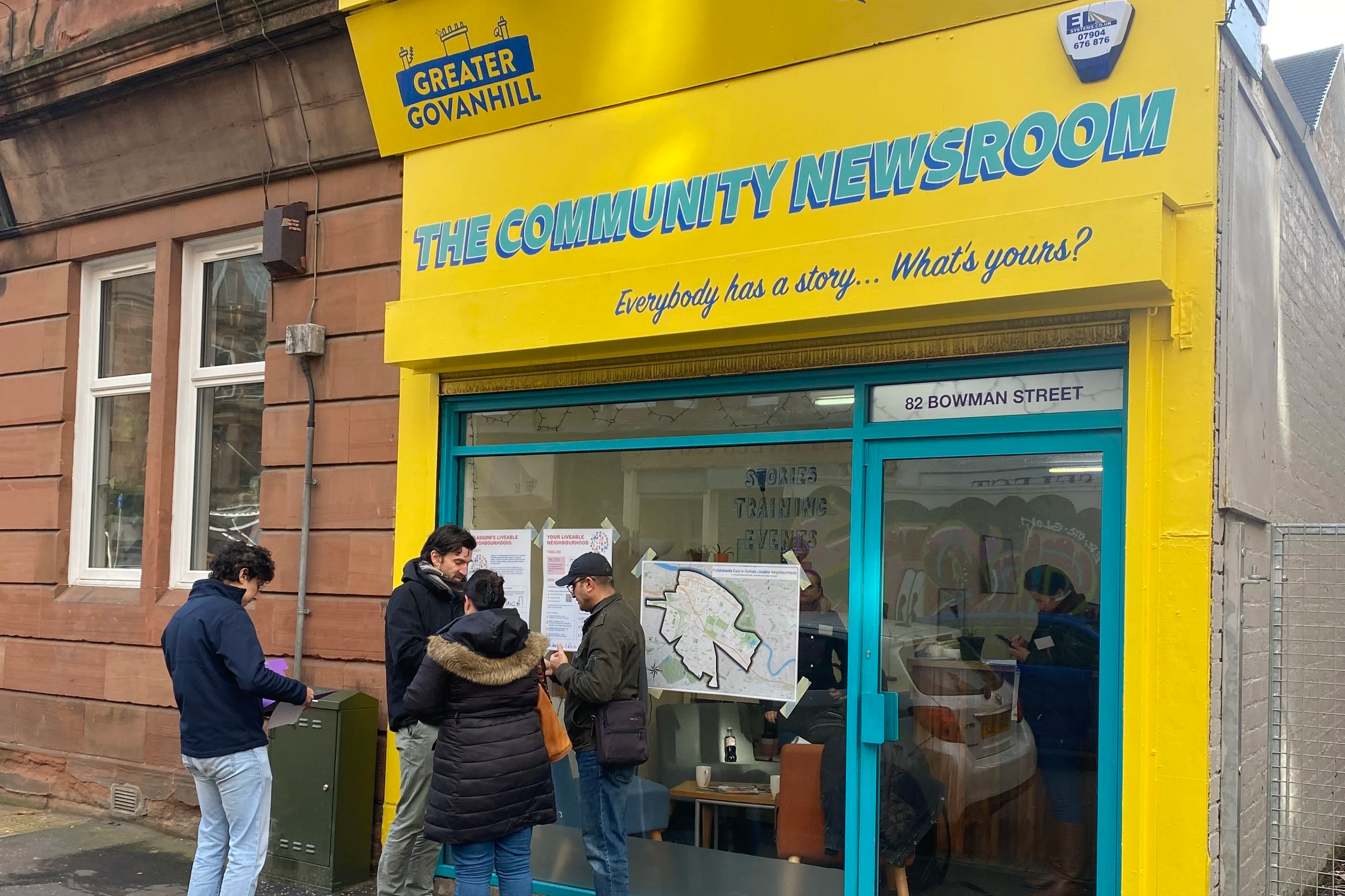
The Community Newsroom, where Greater Govanhill is based
By Samar Jamal | Photo by Greater Govanhill
A number of local organisations providing vital community work have been unsuccessful in their bid for the Glasgow Communities Fund.
The council-run fund provides three-year grants to Glasgow-based organisations and charities. It aims to tackle poverty and inequality across Glasgow by building the skills, capacity, and resilience of individuals and communities. It supports services and activities that reduce disadvantages, promote inclusion, and enable people to participate fully in the social, economic, and cultural life of the city, particularly those facing inequality or with protected characteristics. Guided by the belief that communities are best placed to identify and deliver solutions, the fund prioritises improving wellbeing, strengthening resilience, and encouraging active participation.
Applications were submitted in April, with decisions not issued until December, meaning an eight-month wait, which was delayed beyond the date previously given. Many have criticised this lengthy process as well as the application form itself, which was over 30 pages long. Recommendations on outcomes were made by council officials with approval from the City Administration Committee.
Of the 463 applications in total across Glasgow, 193 were successful, with the majority of successful applications providing services supporting young people and families.
However, there are many applicants whose bids were rejected, who have been providing critical services and may have to stop once funding runs out. There is no opportunity to appeal decisions.
Some of the unsuccessful applicants in the Southside include South East Integration Network, Women on Wheels, South Seeds, Community Renewal Roma Romeha, and Greater Govanhill. While some of these were new applications, others had received the funds in 2023, meaning a blow to the continued provision of services.
Greater Govanhill falls into this category. For the past three years, it has received support from the Glasgow Communities Fund to cover core operational costs, including the team's salaries.
Speaking about the news, Greater Govanhill founder Rhiannon Davies said:
“This is obviously really disappointing. We hear all the time about the positive difference Greater Govanhill makes to people in the local community. People tell us they feel more connected to their neighbours and neighbourhood because of the work they do – that the magazine makes them feel proud of where they live and makes them want to make it better. So many people have been through our training programmes and have gone to further opportunities because of it.
“Unlike in the USA and EU, there is no funding in this country specifically for community media. So this kind of multi-year, operational funding was essential for us to continue to do all the impactful work that we do. The loss of this funding put the long-term future of the magazine in jeopardy. It’s why it matters more than ever that our readers support our work by becoming members – providing regular, sustainable income for our work
Help us reach our target of 250 members by March and support us to continue: Become a member of Greater Govanhill today
Concerns have also been raised by four Muslim-led organisations that were unsuccessful in their funding bid – including AMINA Muslim Women’s Resource Centre based in Pollokshields, Al-Meezan, Boots and Beards and Sufi Festivals, whose annual events are hosted at Tramway. The latter three have endorsed a letter of complaint to Glasgow City Council's chief executive asking for an independent equality audit, which would assess equality and inclusion.
Another organisation to lose the funding was Community Renewal’s Rom Romeha project, which works alongside the Roma community to provide advice and support services to those affected by poverty in Govanhill, home to Scotland’s second-largest diaspora of Roma people.
Read more: Peer Support: How Rom Romeha built a community approach to removing barriers
Community Renewal is another one of 28 applicants who received funding from Glasgow Communities during the last round but were unsuccessful this time. The grant would have continued funding a service, which provides a “multilingual advice service that provides advice on benefits, housing and EU settlement irregularities.” The loss of funding means that they will likely have to close the service in a few months, when funding runs out.
The Roma community is one of the most marginalised groups in Govanhill, with several studies highlighting barriers such as poor housing and health inequalities. Ann Hyde, the organisation's Roma Policy and Development Manager, spoke about the difference their work has made:
“For the last five years, we have been improving the financial wellbeing of the poorest, most vulnerable families in Glasgow. Our services are essential given the level of in-work poverty and child poverty in the area and the fact that it is many Roma families, and many children, that are living in the streets with the highest levels of poverty.”
Ann added that she is worried about what service could replace the work being done at Community Renewal: “We are the only ones with the staff team who are Roma, who have the lived experience and can provide the support and advice in the languages of the community, and who have the trust of the community. As I said, we are stunned and very concerned about the gap in local service provision should we be forced to close our doors when the current funding ends.”
This also highlights issues about the precarity of the funding landscape and its impact on workers in the voluntary sector. The 2025 Voluntary Workforce Survey, carried out by the Scottish Council for Voluntary Organisations (SCVO) had 1,300 respondents from charities and voluntary organisations. Some 27 percent of them felt that they were “quite or highly likely” to “lose their jobs in the next 12 months”. This is twice as much as the wider workforce. With the number of people feeling they have a good work-life balance falling to 50 percent, a ten percent decrease.
The voluntary sector has been key in providing services often missing or underfunded by the government. But its impact is critical in empowering communities and highlighting the challenges facing Scotland’s most diverse neighbourhood, through information and tools.
Speaking about this research, SCVO Chief Executive, Anna Fowlie said:
“Scotland’s voluntary sector is powered by people who care deeply about making a difference. Our workforce survey shows a strong sense of purpose among voluntary sector workers and commitment to the work they do day in, day out.
“But it also highlights the significant strain being put on voluntary sector workers as a result of the financial pressures that have become all too familiar to the voluntary sector.
“Voluntary sector leaders will, of course, be up for the challenge of delivering rewarding, fair work. Too often this is being undermined by public sector funders. Budget cuts, short-term funding cycles, late payments, incoherent decision-making and poor communication have become all too familiar.
“This needs to change – and our politicians know it. Ahead of the Scottish Budget and Spending Review, the Scottish Government has a real chance to create a funding landscape that is multi-year, sustainable, flexible and accessible. The people and communities served by Scotland’s dedicated voluntary sector workers deserve nothing less.”