Iranians in Glasgow speak out
In Iran, protestors have taken to the streets, demanding change. Met with violence, with many being killed as well as an internet blackout, Iranians in Glasgow’s Southside share their voices as they watch the events unfold, urging for their voices to be heard.
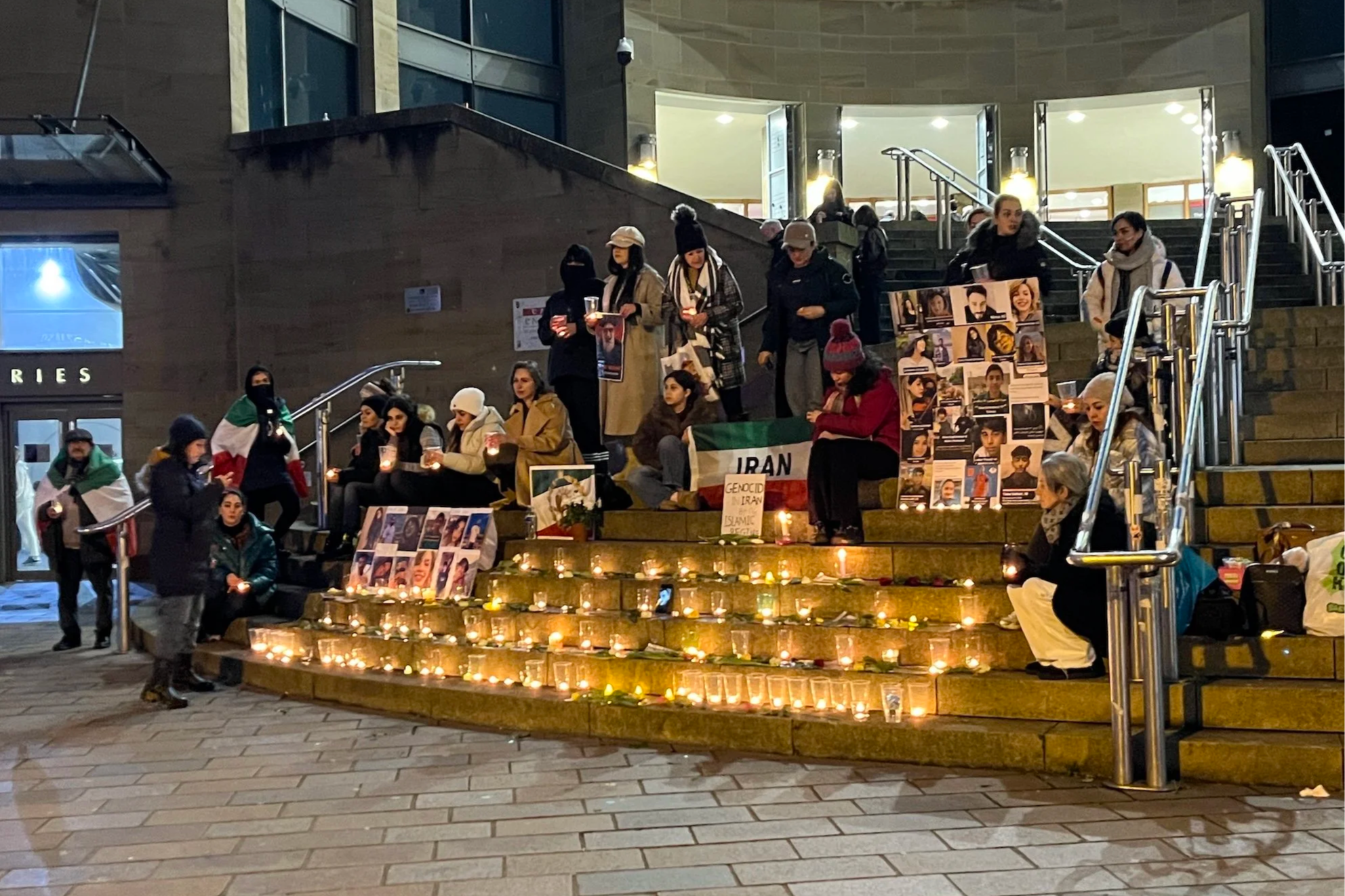
Demonstrators gather at the steps of Buchanan Street – honouring those that have been killed
At the end of December, protests erupted in Iran – responding to inflation and rising living costs. The protests were led by thousands of street vendors in Tehran's Grand Bazaar and soon spread to other parts of the country. Since then, they have evolved into protests against rulers who have governed the country since 1979.
The peaceful protests have been met with violence from officials, with reports from media outlets, foreign officials and eyewitnesses sharing human rights violations. Demonstrators have been shot and stabbed – thousands are reported to have been killed.
An internet blackout was also imposed by authorities, leaving millions unable to contact friends and family, access medical services, or report freely on the situation.
As protests continue in Iran, outlets around the world are reporting on the voices on the ground, with eyewitnesses recounting the impact of the violence and their calls for change. However, this is made difficult with internet blackouts, safety concerns, and access to reporters limited
While Iranians in Glasgow are separated by distance, they are impacted nonetheless, witnessing loved ones injured in the violence and divisions. We heard from Iranians about their fear, hope and what it means to watch from afar.
Nasibeh
For many years of my life, since 1999, I have witnessed people in Iran repeatedly protesting in peaceful ways. Each time, the response from the Iranian government has been severe repression. In the ongoing protests, according to reports by Time, more than 30,000 people have been killed and around 27,000 arrested, many of whom now face the risk of execution. [Editor's note: Some media have reported a death toll of 30,000 [Time Magazine], others have highlighted that these are unverified estimates [Al Jazeera]. Amnesty International have outlined why it has been difficult to verify figures, which you can read below.] All of this happened in the space of only a few days, and I fear it will take a long time before the true numbers of those killed, injured, and imprisoned are fully revealed. Doctors who treated wounded protesters have also been detained, and their lives are now in danger. Bodies of the dead were piled together, and families were told to search for their own children. Thinking about these atrocities deeply wounds my heart and soul.
Watching this unfold from Glasgow is unbearably heavy. It feels like living in two worlds at once. My heart and mind remain in Iran, full of fear and grief, while my body is here and expected to continue everyday life. This constant fracture between where I live and where I belong is emotionally crushing.
I ask the people of Glasgow to stand with Iranians, to help amplify the truth of this violence, so the international community uses every possible tool to support the innocent and incredibly brave people of Iran.
Heydar Abdi, 40 years old
I am writing this from Glasgow, but my thoughts are in the streets of Iran every day. Ordinary people – students, workers, mothers, and teenagers – are being met with bullets and prison simply for protesting against poverty, injustice, and repression. This is not a normal political dispute. People are being killed and crushed by their own government.
For three weeks, the internet in Iran has been almost completely shut down. No calls. No messages. No way to know if loved ones are alive. Imagine not knowing whether your child, who left home in the morning, will ever come back. Imagine unarmed people in your neighbourhood facing military-grade weapons, while the outside world hears almost nothing.
These protests are not about luxury or abstract political ideals. Many people in Iran struggle to afford bread, medicine, or rent. They are protesting against daily humiliation, constant fear, and a future that feels darker each day.
Watching this from Glasgow brings anger and deep sadness, but also hope. Hope in the courage of people standing with empty hands against violence. I urge readers to pay attention, talk about what is really happening in Iran, and stand in solidarity with the protesters. Even listening, sharing information, and showing empathy help ensure that the voices of people trapped behind internet blackouts and repression are not silenced.
Marzieh, 42 years old
Watching events unfold in Iran from Glasgow has been devastating. On 8 January, I knew that my entire family was planning to attend peaceful protests. Before 8pm that evening, the internet was completely cut off. For days, we had no information. Fragmented reports began to emerge of mass killings, of people being shot with live ammunition. One video showed families searching through thousands of bodies in a morgue, looking for their loved ones. Seeing fellow Iranians endure this was unbearable; not knowing if my family was alive was even worse.
Two weeks later, I finally spoke to them. My niece, crying, described how security forces fired at protesters from both the front and behind. My nephew was shot from behind; the bullet hit his thigh. His friends drove him around for hours, too afraid to take him to a clinic, as wounded protesters were being arrested or even executed. He was eventually treated in secret at a private practice. Pharmacies refused basic medical supplies unless names were registered – a tactic used to identify and detain protesters.
From Glasgow, I feel helpless, but I urge people here to keep paying attention, to amplify Iranian voices, and to stand in solidarity with those risking everything for freedom.
Ali Zaregol, 44 years old
Words are inadequate to convey what is unfolding in Iran. Perhaps images can reveal fragments of the catastrophe. The sources that I – and many other Iranians – follow for news of the protests are saturated with videos carrying the warning: “disturbing images.” As an Iranian living outside the country, I watch every one of them.
And so, I spent twelve suffocating minutes walking beside a troubled father as he moved among hundreds of bodies laid out on the floor of a morgue, searching for his teenage son. He whispered desperately, again and again, “Sepehr, where are you, my son?” Together with that father, I passed a mother cradling the head of her teenage daughter in her lap, wailing over her death. For twelve agonising minutes, I walked with him and whispered with him: “Sepehr, where are you, my son?”
Many families testify that, in order to retrieve the bodies of their loved ones, they were forced to agree to bury them as supporters of the regime – falsely claiming they had been killed by protesters. Consider this carefully: families are demanded to pay a large sum of money as the “cost of the bullet” to receive the body. Imagine being forced to pay for the bullet that ended the life of your loved one. [Reports from 2019 by Amnesty International corroborate this information. Greater Govanhill was unable to source reports from 2025]. Do you think that is too vile, too wicked, too grotesque to be real? For the people of Iran—mothers, fathers, brothers, sisters, husbands, wives, ordinary citizens like me and you—this is the morbid reality of today”
For a Western audience, it may seem unimaginable that a state’s security forces would carry out a mass killing of their own people. Yet this is the reality of Iran today. For almost three consecutive weeks, the authorities have imposed a near-total internet blackout, severing 90 million people from the outside world in the 21st century. Shielded by this enforced darkness, they have confronted protesters with military-grade weapons, deliberately turning streets into rivers of blood as a display of power and intimidation.
This may sound like a nightmare beyond comprehension. But it is the bitter, ongoing truth in Iran, and there is irrefutable evidence for every part of it. The images exist – images so harrowing that merely watching them can push a person to the brink of psychological collapse. And yet the people of Iran are living this reality with their flesh, their bones, sacrificing their lives.
I watch these images from Glasgow to keep my anger alive – to resist numbness in the face of such boundless brutality – and to stand alongside my people in the struggle to bring this nightmare to an end.
How many people in Glasgow know the true extent of the massacre unfolding in Iran? How many have seen the videos sent by Iranians who have witnessed these crimes firsthand? How many understand what it means to live under a system that kills, silences, and then demands payment for the dead?
I am not asking for grand gestures from my fellow Glaswegians. A willingness to learn, to become more aware, and to speak about what is happening in Iran is already an act of empathy – one deeply valued by those of us in the Iranian diaspora.
How many people have been killed by security forces?
On 17 January, in a public speech, Ali Khamenei, the Supreme Leader, said “thousands of people” were killed. Since then, on 21 January, Iran’s Supreme Council of National Security issued a statement that 3,117 people were killed during the uprising. However, on 16 January 2026, the UN Special Rapporteur on Iran, Mai Sato, said in a media interview that at least 5,000 people had been killed, noting that according to information she received from medical sources, the death toll might be as high as 20,000 . Due to the ongoing internet shutdown, the scale of mass killings that took place and Iranian authorities’ well-documented pattern of carrying out reprisals against families of victims who speak out, the true number of those killed is likely higher.
The ongoing internet shutdown prevents people in Iran from communicating with the outside world. This makes gathering and verifying information difficult. Verified videos and eyewitness accounts Amnesty International has been able to obtain and review, reveal security forces carrying out mass unlawful killings on an unprecedented scale amid the shutdown.
In the aftermath of the massacres on 8 to9 January, medical facilities were overwhelmed with injured protesters, while distraught families gathered at hospitals and overflowing morgues, searching for their missing loved ones.
How you can help
There are several organisations and charities currently working to amplify the voices of Iranians, and charities are working on the ground to provide medical assistance to people in Iran. You can support the work they are doing by donating or sharing their campaigns.
Doctors Without Borders: A humanitarian charity working on the ground to provide medical relief to countries across the world, including in Iran
Iran on Human Rights: A non-partisan, politically independent organisation that works towards empowering civil society and human rights according to the Universal Declaration of Human Rights.
Amnesty International: A human rights organisation that works towards investigations and campaigns towards a safer and just world, while encouraging public mobilisation.
International Committee of the Red Cross: The largest humanitarian network in the world, working to protect and assist countries affected by violence.