Scots Education in 1960s Govanhill
Braw Bricht Moonlicht Nicht, David Doren’s education was a proper Glasgow journey. He looks back at the teachers who shaped him, the history we’re at risk of losing, and why he reckons every Scottish school kid deserves a chance to find their voice in Scots.
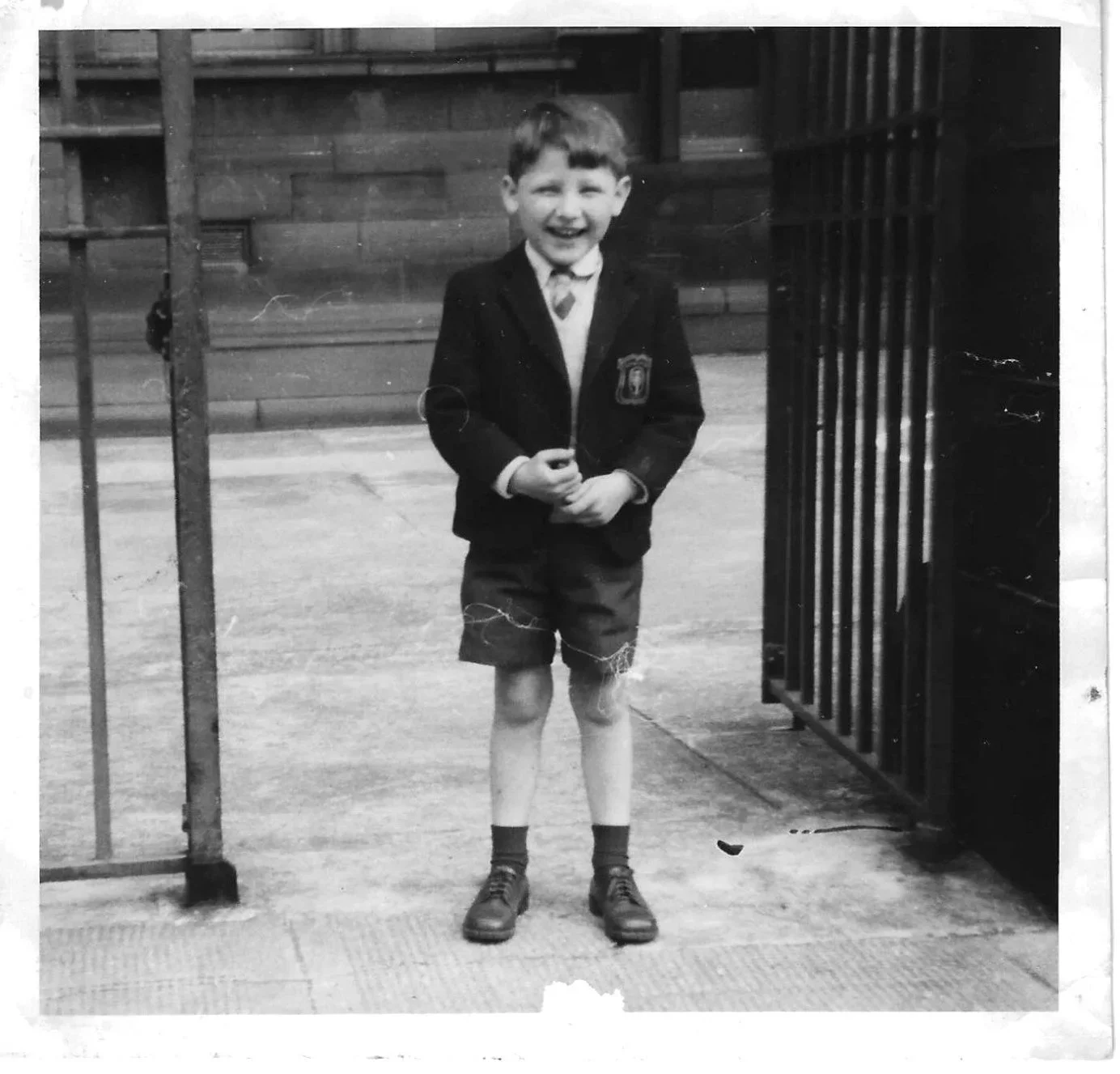
David Doren on his first day at Cuthbertson St Primary
By David Doren
I had two older sisters who were the bane of the teachers’ lives at Cuthbertson Street Primary School in the early 1960s – with their unruly behaviour towards the teachers’ authority. I attended the school for a year, and the only noteworthy thing I can remember of that time was the teacher showing the class how to brush our teeth properly and very little else. I have no recollection of being taught to read and write during this period.
My youngest sister was, like me, left-handed and one teacher would take great delight in using a 12 inch ruler to smack her knuckles, to make her use her right hand for writing. When she left to join my other sister at Queen’s Park Secondary in Toryglen, my sisters begged my parents to have me moved to another primary, as the teachers they had at Cuthbertson Street would take it out on me and make my life there a misery.
My parents considered Hutchinson Grammar School in Kingarth Street, but its fees were too expensive, even with my mum working there as a cleaner, making me eligible for a reduction. My parents' next option was St Kevin’s Preparatory School, in Queen Mary Avenue. So my parents scrimped and saved to afford the fees to have me attend St Kevin’s, and get a better education than my siblings.
St Kevin’s Preparatory School was very progressive in its day, compared to other local primary schools. The school was housed in one of the large mansion houses in Queen Mary Avenue, with two large trees on either side of the gated entrance. There were seven classrooms and up to 15 pupils per class, aged from five to twelve. The core principles of learning the three Rs (reading, writing, arithmetic), were at its heart
In my second year at St Kevin’s, we learned about Scottish history, such as Mary Queen of Scots’ turbulent life and the Battle of Langside. One day, a group of older boys returned from a walk in Queen’s Park with what looked like a battle axe. Mrs Travers made a call to a museum to have the axe examined, and it turned out it roughly dated back to the time of the Battle of Langside. It went into a museum collection.
We learned about Rob Roy, William Wallace, Robert the Bruce, the Glencoe Massacre, the Jacobite Rebellion. We studied architectural giants such as Alexander (Greek) Thompson and his designs for churches, houses and other buildings, Charles Rennie Mackintosh with his distinctive designs and attention to detail. I loved learning about how in Queens Cross Church, he raised the pipes supplying the radiators against the main walls in the church for run along and under the pews, so during the winter months, the church’s congregation would be warm and dry, as churches of the time were large and cold. Or how with the School of Art, he positioned large glass windows to face the rising sun, to flood the studios and workrooms with natural light.
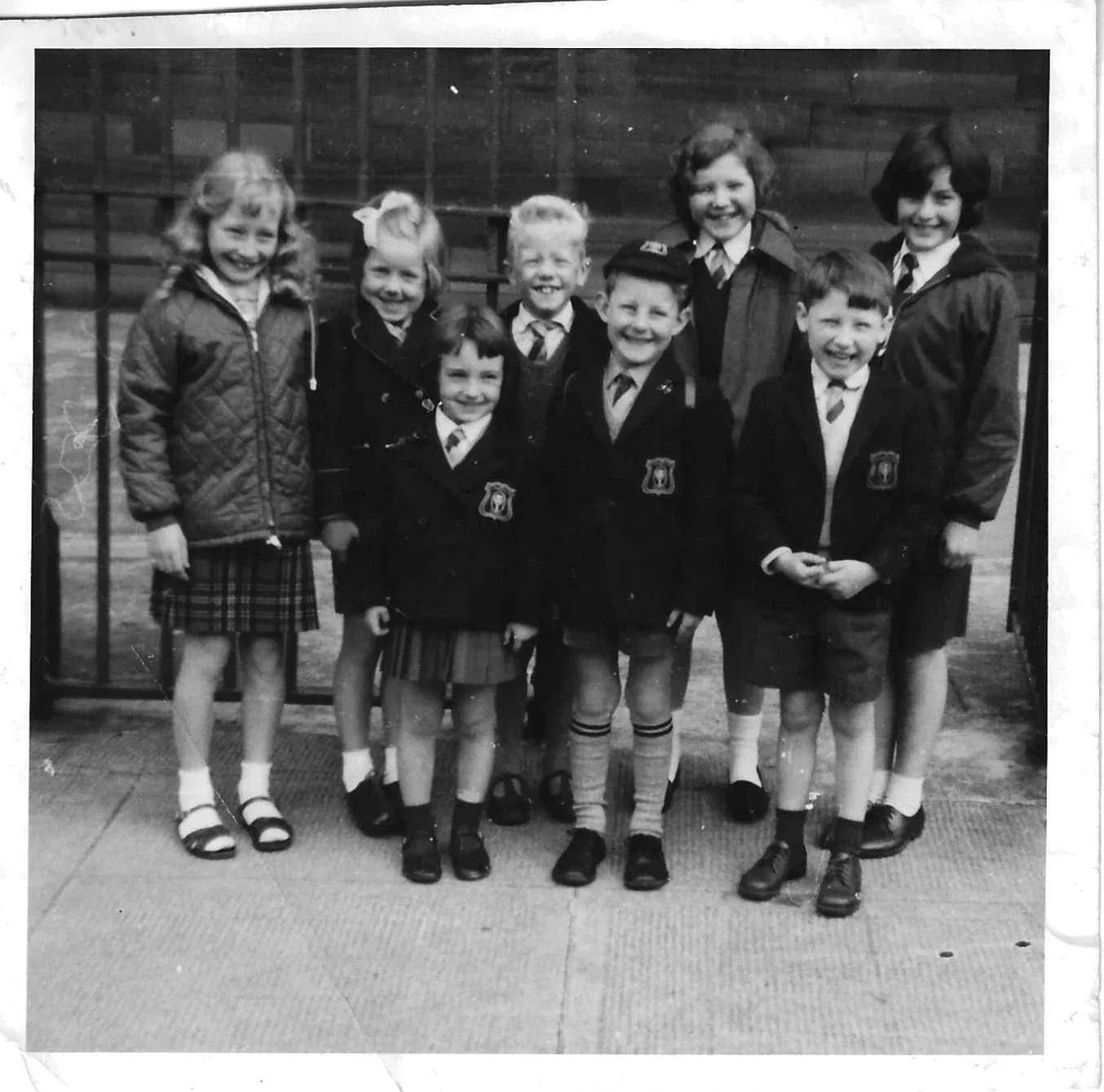
We were also taught about the classic Scottish authors, like Robert Louis Stevenson, Sir Walter Scott and of course the Scottish Bard himself, Rabbie Burns – the people’s poet.
My mum was brought up on Rabbie Burns, and had a full collection of his works – I can remember them vividly. They were bound in black leather, with gold leaf etched onto the cover and binding. Between school and home, I went through all his works, my favourites being Tam O’Shanter and An Ode Tay A Moose.
It was our headteacher, Mrs Travers at St Kevin’s, who insisted we learn Broad Scots in order to appreciate and understand the works of Rabbie Burns. She believed in a fully rounded education for her pupils. We would have English diction and elocution lessons for the proper pronunciation of the English language. To prepare for our oral tests and get our diction right, we would repeatedly recite How Now Brown Cow.
The Scots equivalent was Tis Aw Braw Bricht Moonlicht Nicht Twa Nicht (It’s A Beautiful Bright Moonlit Night Tonight), which we would say out loud to make our speech lilt and roll off the tongue. Mrs Travers believed that to truly appreciate Burns, we had to immerse ourselves in the Scots language – to read it, write it and speak it.
The Scots language varies from the top of Scotland down to the border. There’s traditional Gaelic from the highlands of Scotland in the North, to Doric around Dornoch, Nairn, Inverness, Fort William, with Scots around the lowlands and central belt, and Lallans closer to the border with England
Compared to other languages, Scots is more a spoken dialect rather than a written one, meaning there is no right or wrong way in how you write Scots down, only that it can be understood by others.
I believe much of Scotland’s history – its writers, historical figures, culture and language (other than Gaelic) – is being lost. It doesn’t seem to be a priority in Scottish schools to learn Scottish history, literature and language in the way we once did. What we were taught at St Kevin’s now seems confined to further education or university level.
The Scots language has been dying out, with mostly the older generations still holding that knowledge and usage – and we are sadly dying along with it. In Govanhill in the 1960s, there were several members of the older generation who could speak, read and write Scots in one form or another, but this has not been passed down to younger generations. Burns Nights are often the only times when people recite Burns in its original form and give the Address to a Haggis.
I hope that when children learn the likes of Burns at school, they are given the chance to understand the language and culture behind the words, as we were. I will always be grateful for the Scots education I received, and I’m pleased to see Scots now recognised officially as a language in its own right.
The publisher acknowledges receipt of the Scottish Government’s Scots Language Publication Grant towards this publication.
