‘That’s Us!’ – Learning to be at Home with Scots.
From Poetry on the Underground to Govan classrooms, one incomer traces how Scots slipped into his speech – and his singing – as a lived language of belonging.
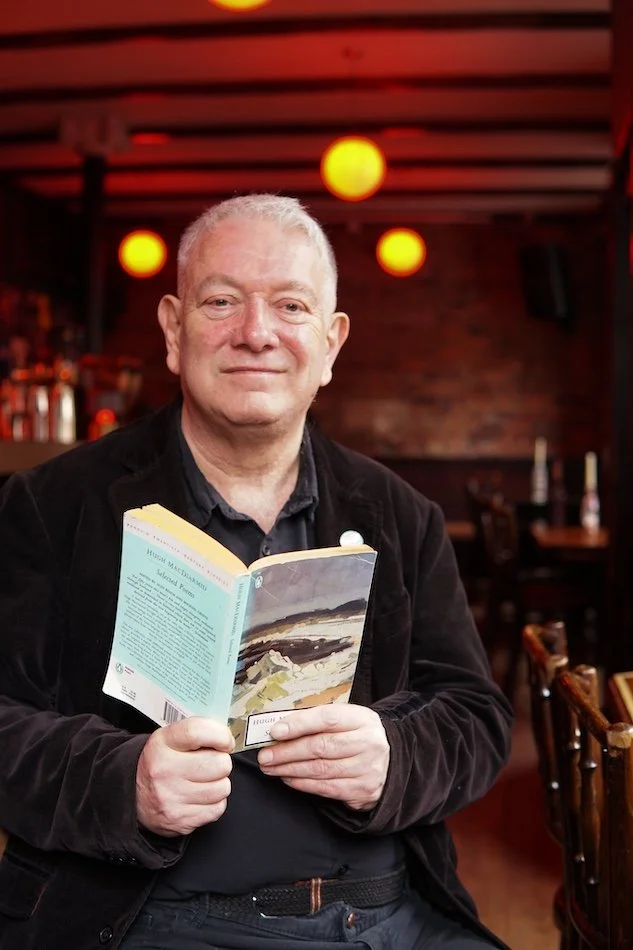
By David Carr | Photo by Rob Reid
My first encounter with Scots was while strap-hanging on the London Tube. Before me at eye level was the text of Hugh MacDiarmid’s Lallans Scots poem, The Bonnie Broukit Bairn, displayed as part of their Poetry on the Underground series. What was this? Dialect? Slang? Whatever it was, it was clearly poetry.
I had never been to Scotland until I met my late wife, who was from East Kilbride. The first Scots word she taught me was pinkie – she was showing me a guitar chord – which I found inexplicably hilarious. Cath was a probation officer when we were down south and she would sometimes tell me of her colleagues poking fun when she used Scots legal terms in her reports, ‘The client pled guilty’ or ‘The client is living outwith the family home’. Right now, Google Docs is telling me that pled and outwith are spelling mistakes.
I visited Scotland a couple of times with Cath before moving to Glasgow to be near her family. I took to it instantly. The Scottish vibe seemed so different to the late eighties loadsamoney culture I was struggling with on the outskirts of London.
In my new home, I was immersed in many new Scots words, especially around Cath’s family. Sometimes they confused me – like press for cupboard – but they were all amused when I called my niece a wee besom. I was also finding out about Scots culture. Cath was a bit of a folkie and introduced me to the likes of Dick Gaughan, whose lyrics I could not yet decode.
I still didn’t know what Scots was. It seemed to pepper everyday Scottish English at all levels. I was used to a small handful of dialect words in my native Scouse, but Scottish English has many more borrowings from – I would learn – the separate language of Scots. Scottish English seems to me to be a palimpsest – a manuscript written in English over a Scots text which is still visible, keeking through between the lines.
Scottish English can have a refreshing informality. For all that Scots words are used in the fantoosh world of procurators fiscal, they are more often signifiers of working class identity. One of the attractions of Scottish culture for me was its demotic, egalitarian character. It would become natural for me to adopt Scots words and occasionally grammar for my own. It was part of fitting in.
I am fascinated by code switching – the phenomenon whereby we can all drop into different types of speech depending on context. My children, raised in the leafy suburb of Clarkston, possibly use less Scots than I do. Visiting the pre-gentrification Barras Market, my daughter once asked, “Dad – why are you speaking Scottish?” I especially get a buzz from code switching mid sentence – when Scots words are dropped to give informal rhythm into a high register utterance – as when someone recently told me, “I have a pure stauner for semiotics.” Ooh, the banter.
Most of my Scots has come to me through osmosis and a geek fascination with language. There isn’t really a Scots learning community, which is unsurprising given the systemic denigration of Scots as low-class slang. There is a little gatekeeping. If you don’t speak the purest Doric at hame, if you don’t already know that syne, as in auld lang, is pronounced with an s and not a z – then you’re not speaking true Scots. I find less of this attitude amongst the more open Gaelic learning community – although there one is somewhat expected to get off on Gaelic music, which I don’t especially.
If there is such a thing as a Scots learner, they are possibly to be found in my classes at Maslow’s Community in Govan, where I volunteer as an English teacher, mainly to asylum seekers and refugees. I have a dilemma here. The most important thing for me to teach is Standard English. My learners aspire at some point to pass the British citizenship test, which requires a degree of fluency. But the language they hear on the streets, especially in working class Govan, is Scots.
The irony of an English guy attempting to teach Scots in Govan does not escape me. It’s a reversal of empire in miniature.
My learners will have generally picked up that Scottish people say aye for yes. But for some of my learners, even wee for small comes as a surprise. My favourite word to teach is dreich, with its non-English -ch sound. My learners now have a word to describe the Glasgow weather.
I am famed amongst my learners for ending lessons with the perplexing Scots construction, “That’s us!” – is it just Glaswegian? It’s a quick win for them to say “Is that me?” to a shopkeeper and to hear back “Aye, that’s you, pal.”
When I was invited to join the Whit Aboot Ye? Scots writing project, I was sceptical. Ah cannae scrieve Scots wi oot comin o’er like a pure patronisin wee daftie.
But, dammit, after more than half my life in Scotland, the ease with which I now include Scots within my idiolect – my personal speech habits – reflects my sense of belonging. Certain Scots words have become my default speech. The other day, I couldn’t remember the word controversy. Stooshie seemed more fitting.
My appreciation of Scots goes deep. I have read a fair amount of Scots literature – from MacDiarmid, who is credited with a renaissance in Scots, to Len Pennie, who is popularising contemporary Scots poyums for a TikTok audience, via Irvine Welsh’s Embra Scots – a world away from Edinburgh English.
We all speak a mixture of Scots and English – although native speakers’ experience of Scots will have been different to mine. My natural Standard English has never been belittled out of me. I have added my layer of Scots to it as a badge of identification, of assimilation, of inclusion.
I am a singer. I sing mainly with Govanhill Voices, I organise singarounds at Ryan’s Bar and I fairly recently braved an open mic at the Keelie Folk Club at McNeill’s. I have, inevitably, some Burns in my repertoire. Ae Fond Kiss is simply a gorgeous song. But my party piece – the song I think I sing best and which most speaks to me as an incomer – is Hamish Henderson’s Freedom Come A’ Ye. Its Scots lyrics are – challenging – even to native speakers of Scottish English. But they are worth learning. They sing of an outward looking, internationalist Scotland which welcomes those from other lands. Its sentiments are what makes Scotland – and Scots – feel like home.
The publisher acknowledges receipt of the Scottish Government’s Scots Language Publication Grant towards this publication.
