Three minutes on Kenmure Street: we asked FM John Swinney your questions
After months of speaking to residents, holding street stalls and gathering readers’ concerns through our Citizens Agenda project, we were able to put questions from our readers directly to First Minister John Swinney on the campaign trail in Pollokshields.
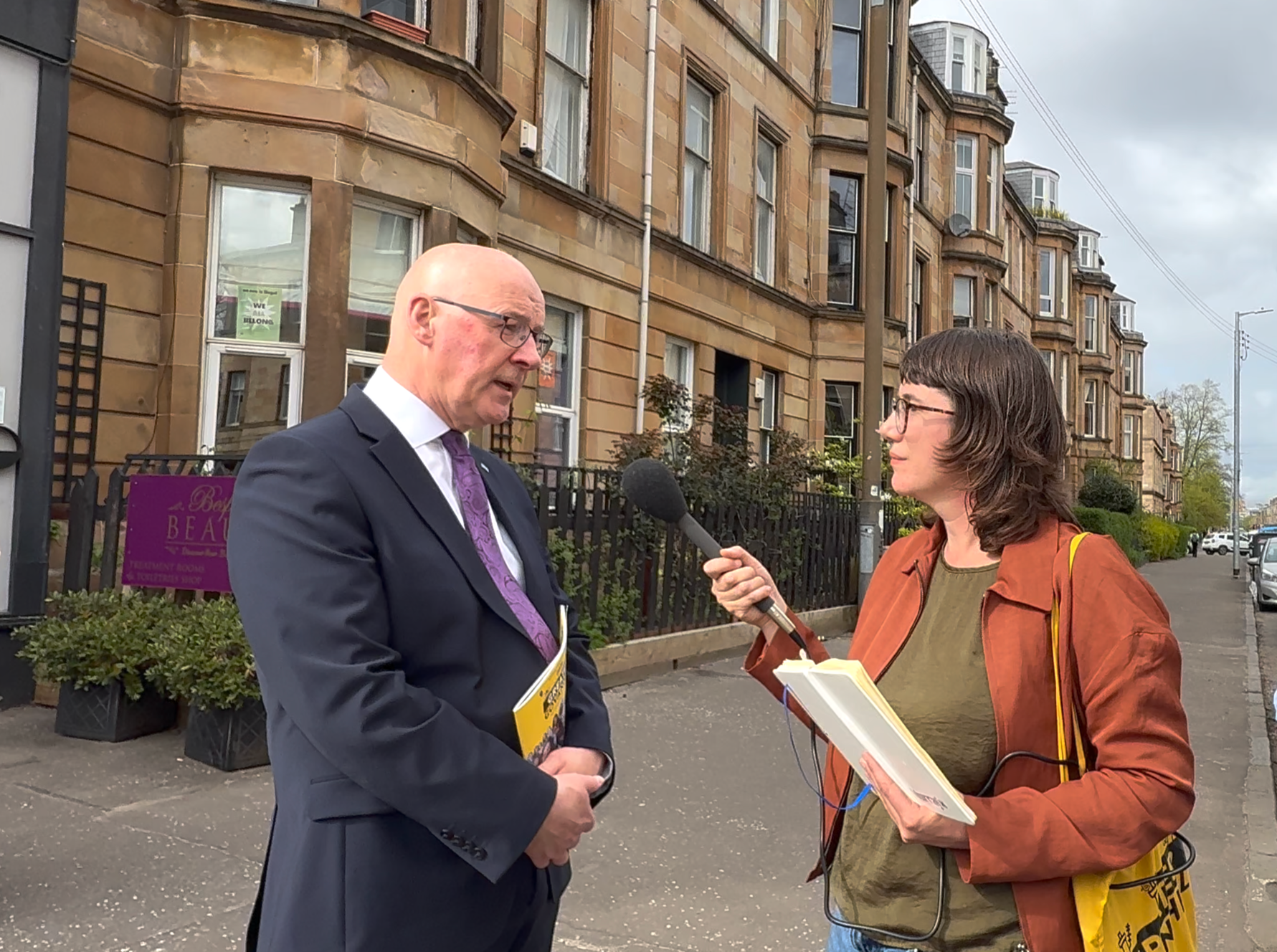
Greater Govanhill founder interviewing First Minister John Swinney in Kenmure Street
By Rhiannon J Davies | Photos by Krystal Lindsey
It was a typical April day in Glasgow, as we stood on Kenmure Street on Monday afternoon waiting for the arrival of Scotland’s premier; the sun bore down, dark clouds gathered, and the odd spit of rain threatened to ruin the show. We were there just after 3pm, so children headed towards the playground at Maxwell Park, and families bustled through the neighbourhood on their way home.
Five years earlier, this same stretch of street was the site of one of Scotland’s most celebrated demonstrations in recent times. The spontaneous community protest – a show of solidarity that led to hundreds of people occupying the street to prevent the deportation of their neighbours – has become a defining moment in the Southside’s political history, and was the subject of a recent film that has taken international film festivals by storm.
Read more: Everybody to Kenmure Street to open the 2026 Glasgow Film Festival
We had been offered a last minute interview with First Minister John Swinney, who was out on the campaign trail in a bright yellow bus emblazoned with his own face and the slogan ‘on Scotland’s side,’ together with Southside candidate Kaukab Stewart and party list candidate Declan Blench.
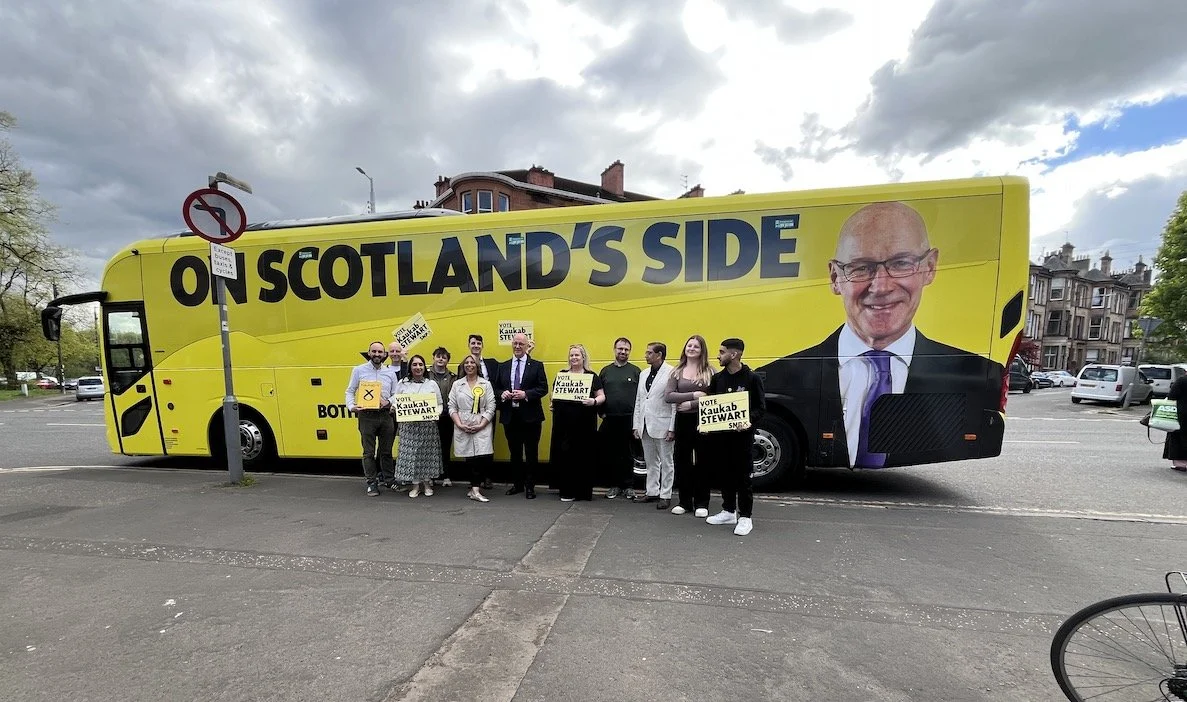
John Swinney and SNP campaigners in Pollokshields
They were meeting voters, campaigning as they attempt to hold onto power in what is shaping up to be one of Scotland’s most closely fought elections in years. While the SNP are still expected to remain the largest party, current polling suggests they could lose a number of seats, while Reform UK may emerge as the main opposition.
Distancing themselves from the anti-migrant rhetoric of Reform, the SNP campaign had come to Kenmure Street to announce that, if re-elected, they would:
Increase funding for the Bridges Programme and Refuweegee, which supports the integration of refugees and asylum seekers
Increase use of the New Refugee Doctors Project, which supports medically trained and qualified refugees to achieve medical registration and contribute to NHS Scotland
Set up a Gaza Student Scholarship for postgraduates, supporting Universities of Sanctuary which exist in Scotland.
Establish a Palestine Arts & Creatives Support Fund to support creatives to come to Scotland
Continue specific international development funding for Gaza, recognising the level of devastation caused by the actions of the Israeli government.
At Greater Govanhill, we have spent the past couple of months attending community groups, surveying readers online, holding street stalls, and asking one simple questions: ‘What do you want candidates to be speaking about as they compete for your votes’.
This means that when it came to interviewing the First Minister, we were able to put some of your questions directly to him – in the three minute slot we were offered.
Here in the Southside there are a lot of concerns around issues like rubbish, rats, fly-tipping and a general feeling of neglect of the area by the council. For years, campaigners have been calling for Glasgow to receive a greater allocation of government funding to mitigate inequality. Given that £10 million was found for those affected by the Union Street fire – proving that money can be found when there is political will – what would your government do differently to ensure Glasgow doesn’t feel it has been left behind?
Well, I think what we do in general is make sure that local government is as well supported financially as we can manage, and local government in general got a real term increase in the last two budgets under my leadership. Obviously the distribution of those resources is agreed within local government, but indicators such as deprivation will significantly drive the distribution of those resources.
With the Union Street fire – what I’ve tried to do – is recognise that the fire was of such a scale for the city that it was unfair for the city to be dealing with that on its own. So that’s why I intervened as quickly as I did to support the city council. That’s what government should do.
Taking that forward in our manifesto, by making commitments for example to the restoration of the People’s Palace or the maintenance obligations on the Clyde Tunnel, those are designed to take some of the financial pressure off the city council so its resources don’t have to go as far on other topics as they may have expected them to do.
I’m trying to make sure the city council is able to have access to a greater proportion of its resources without these exceptional issues being a burden. That’s part of what I’m trying to do to strengthen the capacity of the city council to address the important issues you’ve raised.
We’re standing in Kenmure Street where the events of five years ago show how people in areas like Pollokshields and Govanhill are really proud of the migrant communities that have settled here – and the sense of belonging that exists. What will your government do to counter the rise of racist rhetoric, and make communities feel more connected and cohesive?
An essential part of my politics is about making sure that Scotland is a cohesive and inclusive country. That’s how it’s always felt to me, but I listen to too many people telling me that it doesn’t feel like that in their experience.
So I’ve got to give – and I give this openly – the willing political leadership to make sure Scotland remains a tolerant, inclusive country. That’s how I will go about my business, and I will work at all times to try to deliver that cohesion.
There are practical steps we can take around raising awareness and encouraging community cohesion. The We Are Scotlandcampaign we took forward at the tail end of last year was designed to have that message of cohesion right at its heart, recognising how people are feeling just now.
I watched the situation on Kenmure Street with admiration – the willingness of the community to act, to represent who the community is. I want to make sure that’s how people feel, and that they can rely on me as First Minister to represent that type of cohesive approach.
I think we’re at a really difficult moment because we have got this body of opinion making its voice heard through Reform. I think it’s fundamentally divisive, and I want to make it crystal clear that there will be no cooperation, no collaboration between me and Reform in the aftermath of the election campaign, because it’s too important that we remain a cohesive society to dabble with anything like that.
Up until recently around here we’ve had the Saltire/Palestine flags flying showing the level of support for the Palestinian people. A lot of people are calling for the Scottish Government to do more to prevent the war and prevent complicity in it. What will your government do to take a stronger stance on that?
Well, I set out to Parliament in September a whole range of steps that we can take within our powers. Now I understand people will want us to do more – I can only operate within the powers I’ve got available to me.
It frustrates me. I want Scotland to be independent. I want us to have a voice of our own in the world. I want to make sure that’s heard and can be of influence.
But I would assure people in this community – I’m appalled by what has happened in Gaza. My stance has been so consistent in opposing that, and I want to make sure we do everything we can to pursue that policy.
Housing is a huge issue around here. We have rogue landlords, rising rents, and many people experiencing unsatisfactory housing conditions. What would your government do to tackle this crisis?
Well, we’ve just legislated on rent controls, and I think it’s a really important commitment that we have delivered for people to give them strength and rights.
I also want, where individuals are renting and a property is proposed to be sold, to make sure they get the right of first refusal on that at an affordable price.
Obviously there are housing standards that have got to be maintained in all circumstances. There are all sorts of issues about public safety and householder safety that have got to be addressed, and the regulatory powers to do that are in place to make sure people are protected. I want to see those applied vigorously at local level.
My final question is around the closure of cultural and community spaces. We’ve seen threats to Trongate 103, the closure of CCA, and other local community organisations – including ourselves – have our funding cut. What will your government do to protect the important cultural and community spaces that exist in Glasgow?I think it’s vital that we have a vibrant range of cultural venues in our communities – across the city centre and in outlying communities. It’s absolutely vital that those exist and that people have the opportunity to access those services.
Part of what I’ve tried to do has been to increase the resources available for cultural organisations in Scotland. We’ve seen that grow in each of the budgets I’ve presided over as First Minister, and I’ve committed in the manifesto to continue that.
What I want to make sure is that we have sustained investment in cultural activity in Scotland, but that’s also got to be a partnership endeavour involving local authorities and other bodies.
If we all pull in the same direction, then we can support all these vital facilities in our communities and make sure they meet the needs of local people.
This week we are analysing all the input we had on our Citizens Agenda project and will be putting a selection of your questions to every candidate in the Southside. Want to know where they stand on the issues you care about? Sign up to our newsletter to read their answers.