Two years ago, Thomas Kerr celebrated Govanhill’s diversity. Now he calls it a ‘ghetto’. We asked him what changed
When we interviewed Thomas Kerr in 2024, he praised Govanhill’s “unique and wonderful character”. Now he is making sweeping claims about migration, crime and exploitation in the area. We asked for the evidence, what changed his view, and how much contact he has actually had with Govanhill.
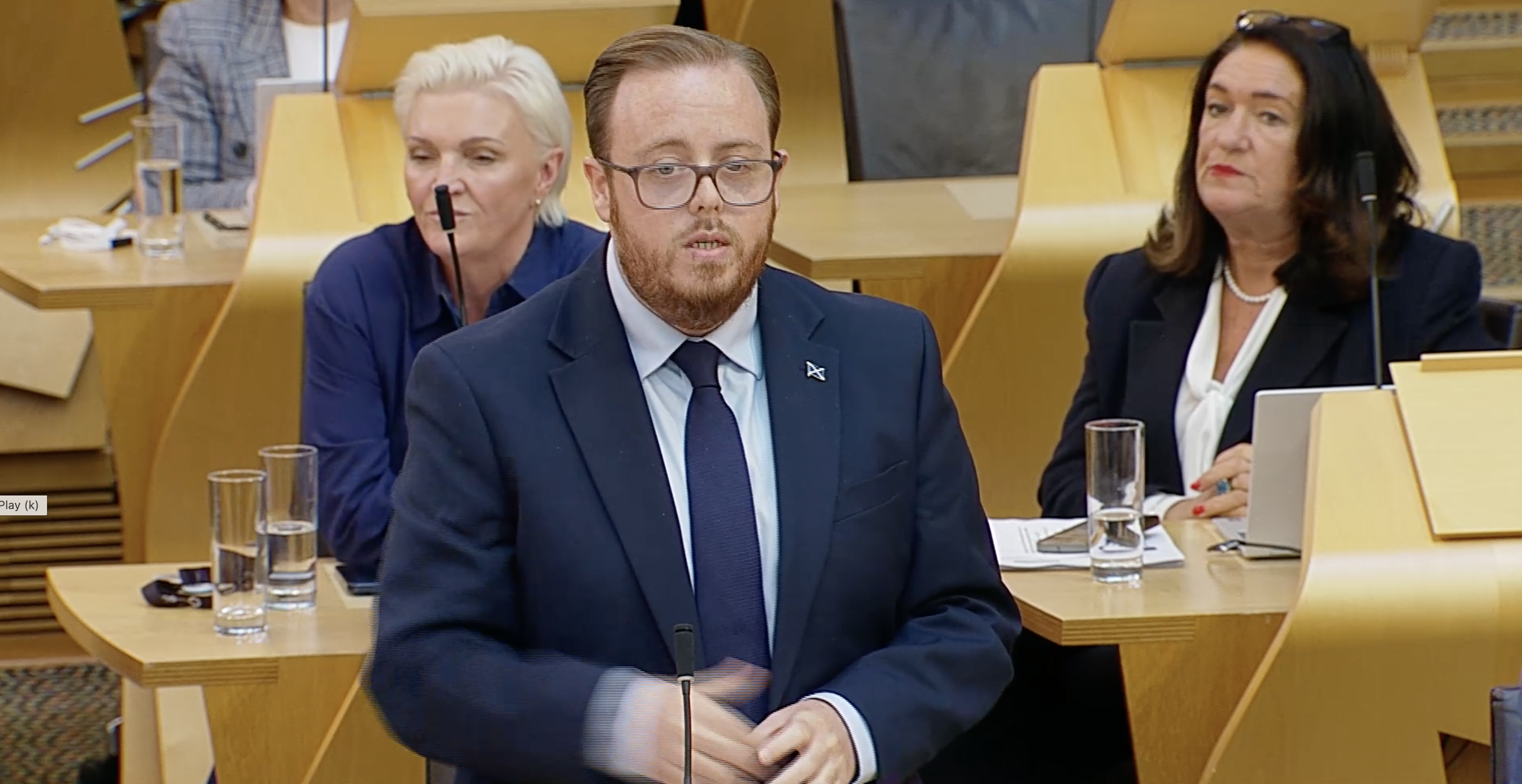
Thomas Kerr speaking at Scottish Government Debate: Building Stronger, Safer and Inclusive Communities, Together | Image courtesy of the Scottish Parliament
By Rhiannon J Davies
Two years ago, Thomas Kerr described Govanhill as having a “unique and wonderful character”.
It was the run-up to the 2024 general election, when he was standing as the Conservative candidate for Glasgow East. We asked him what he thought of the similarities and differences between Govanhill and the rest of the constituency.
His answer was unequivocally positive:
“Govanhill has a unique and wonderful character and one that I hope is never lost. The spirit and diversity in our communities is something to be celebrated. As boundaries change, I am committed – if elected – to working together across the whole constituency to bring communities together, create new opportunities and ensure everyone feels represented.”
Yet last week, in a debate in the Scottish Parliament about building stronger, safer and inclusive communities, Kerr, now a Reform UK MSP for Glasgow, gave a very different description:
“If you want to look at where multiculturalism has failed and integration does not work, look no further than Govanhill, where a once-great community has become a ghetto. Govanhill was once the historic heart of Glasgow’s Jewish community. Now, its reputation is for nothing more than daytime drug dealing, child exploitation, mass illegal migration and street gangs.
“The residents of Govanhill deserve safer streets, decent housing, functioning public services and a genuine sense of community. They deserve politicians who will listen when they see rapid change and put pressure on when they need to. Sadly, the population change means that the community is now represented by an MSP who is more interested in Gaza than in Glasgow. That cannot be good for community cohesion.”
The contrast was stark, so we got in touch to ask Kerr what had changed in his view of Govanhill since 2024. He told us:
“Govanhill was once the beating heart of Glasgow’s Jewish community. They lived in crowded tenement communities but had a community spirit second to none. Post war, they gained economic stability and moved into better housing. Over the years, Govanhill has become filthy with rubbish and seen an influx of people whose values don’t align with local Scots. So yes, my view has changed.”
His answer described changes he believes have taken place in Govanhill over several decades, but did not explain why his own assessment was so different from the one he gave us less than two years ago.
We went back to ask whether he had already been aware of the problems he now cites when he described Govanhill’s diversity as something to celebrate in 2024 and, if so, what accounted for his different assessment today. He did not respond before publication.
Kerr was standing for the Conservatives when he made his comments to Greater Govanhill in 2024. He is now a Reform UK MSP.
We also wanted to know how much contact Kerr has had with Govanhill since becoming one of the MSPs representing Glasgow. He said he had “regular engagement with local residents”, including people who contacted him after his speech who were “scared to say what I said” but thanked him for speaking out.
He did not say whether he had visited Govanhill since his election or identify any community organisations he had met with. We asked him to clarify both points, but received no response before publication.
We also asked what evidence he had for his claim of “mass illegal migration” in Govanhill. Kerr said:
“This is simple. Mass illegal migration means what it says. Given the number of immigration raids, the housing crisis and the fact that Glasgow is a dispersal city, the evidence speaks for itself.”
However, being an asylum dispersal city is not evidence of the number of people living in Govanhill without legal immigration status. A Ferret Fact Service investigation last year examined a similar claim made by Reform UK leader Nigel Farage about Glasgow. It found that figures he had presented as people who had come to Britain “illegally” actually referred to people being accommodated while awaiting decisions on asylum claims. The figures do not show how many people living in Glasgow entered the UK irregularly, and are not available at Govanhill level.
Kerr's description has been challenged by Labour MP John Grady, who was elected as Glasgow East in 2024.
In a statement issued following the speech, Grady said Govanhill, like the rest of Glasgow, had a “strong sense of community” and described its diversity as “a source of strength and beauty”.
He acknowledged that Glasgow faces serious problems including housing and crime, but said: “I strongly reject any suggestion that these issues are caused by multiculturalism.”
And there is a certain irony in the timing of Kerr's description of Govanhill as a failed “ghetto”.
This week, Time Out named Govanhill the fifth coolest neighbourhood in the world, praising its independent businesses, creative scene and diversity and describing its “welcoming ethos” as “Glasgow at its best”.
And just weeks earlier, around 10,000 people took part in this year's Govanhill International Festival and Carnival, with its parade bringing bands, performers, community groups and residents through the neighbourhood's streets.
We set up this magazine to celebrate the diversity of the neighbourhood, and to report on the issues that do exist, often rooted in poverty, inequality and a lack of investment in services and housing, but to do so from a solutions-focused perspective.
We want people to feel proud of their area, and to want to work to make it better. Part of that means challenging the negative stereotypes about Govanhill, which often come from a place of prejudice.
In a debate about community cohesion, we don’t feel that running down an entire area is particularly helpful. Recognising what is good about a place doesn’t mean ignoring its problems.
Thomas Kerr’s own words from 2024 offer a very different starting point: Govanhill has a “unique and wonderful character”, and its “spirit and diversity” are “something to be celebrated”.