Want to know where to buy the most sustainable coffee in the Southside?
From Victoria Road in Govanhill to Strathbungo, Pollokshields and Mount Florida, South Seeds explores Southside takeaway coffee, sustainability, pricing and waste, revealing how local choices can shape a greener Glasgow high street.
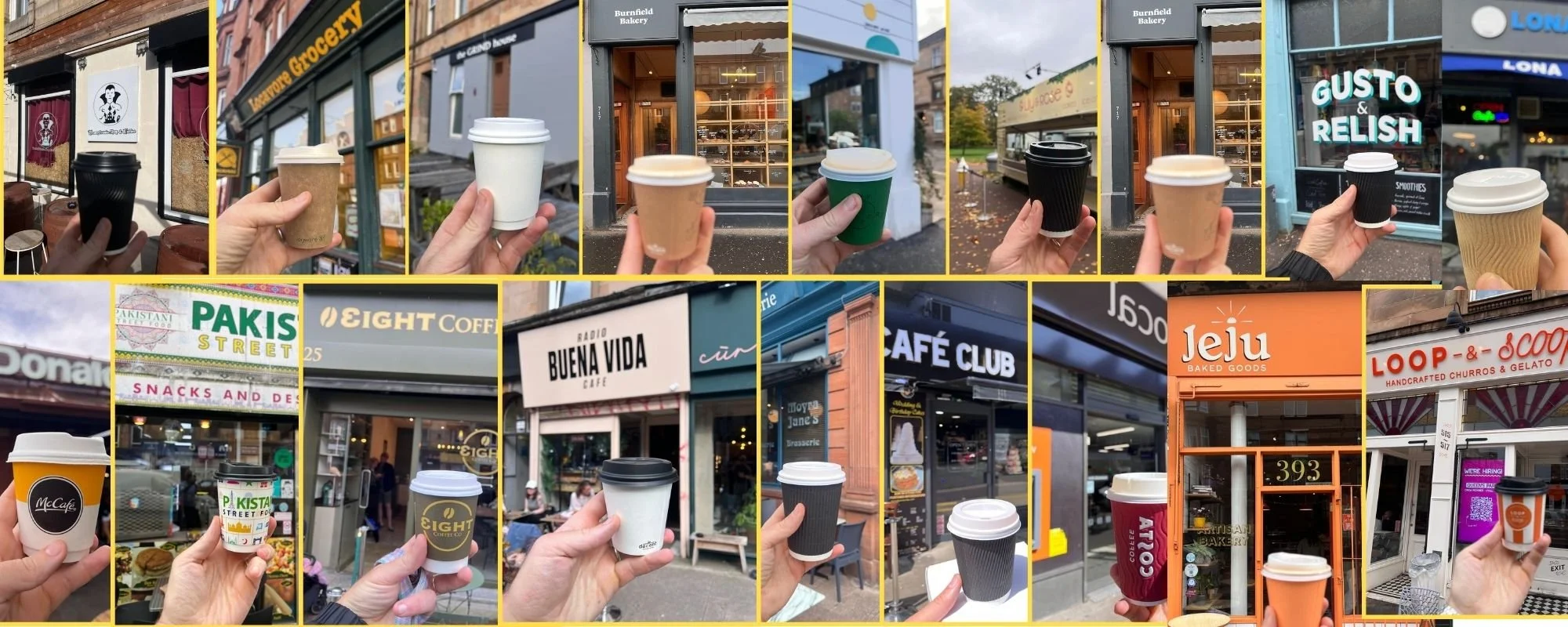
By South Seeds | Photos by Ewan Lachlan
Victoria Road, the main high street within the central Southside area, changes like a kaleidoscope, its shifting shopfronts creating an ever-changing display of colour and character.
Nowadays this array includes ample options for those looking for a caffeine fix.
According to the Scottish Government, in the year 2021-22, an estimated 388.7 million disposable beverage cups were used in Scotland – equating to over 70 cups per person, per year – one of the highest rates in the EU. These create 5,400 tonnes of waste in Scotland annually and are seen as a symbol of our throwaway culture, often contributing to litter in the neighbourhood.
The issue, however, extends far beyond litter. Each takeaway coffee carries a wider environmental and social footprint. These impacts can be reduced when providers take responsibility – through better waste management, fair pricing, and support for public health. Equally, consumers can make choices that reflect their values, helping to shape a more sustainable coffee culture across the Southside.
With this in mind, South Seeds, a local community-led sustainability charity based here in Govanhill, set out to find the most sustainable Southside takeaway coffee – to see if there is a public appetite for more sustainable products and services amongst residents.
Sustainability is about the planet and people, so this was not a survey to see which coffee shop was the most environmental. Instead we took a wider view of sustainability and checked prices and other variables designed to assess how connected they were to the local economy and their contribution towards public health.
To begin, we spoke to the sustainability specialist at Matthew Algie, a coffee roaster based in the Gorbals, which has been supplying cafes and hospitality businesses with everything they need to run a coffee business for 160 years. They took us through some of the key issues with takeaway cups, verifying sources of coffee and disposal of coffee waste.
We also looked into health advice from the British Heart Foundation and the NHS which suggests 200 calories is the maximum for a healthy snack. And we know from running the Southside Tool Library that working with local trades people is a great indication of how well-connected people are to the area. From this we developed criteria which tested environmental credentials, contribution to the local economy and enabling personal health and wellbeing. All the criteria were equally weighted.
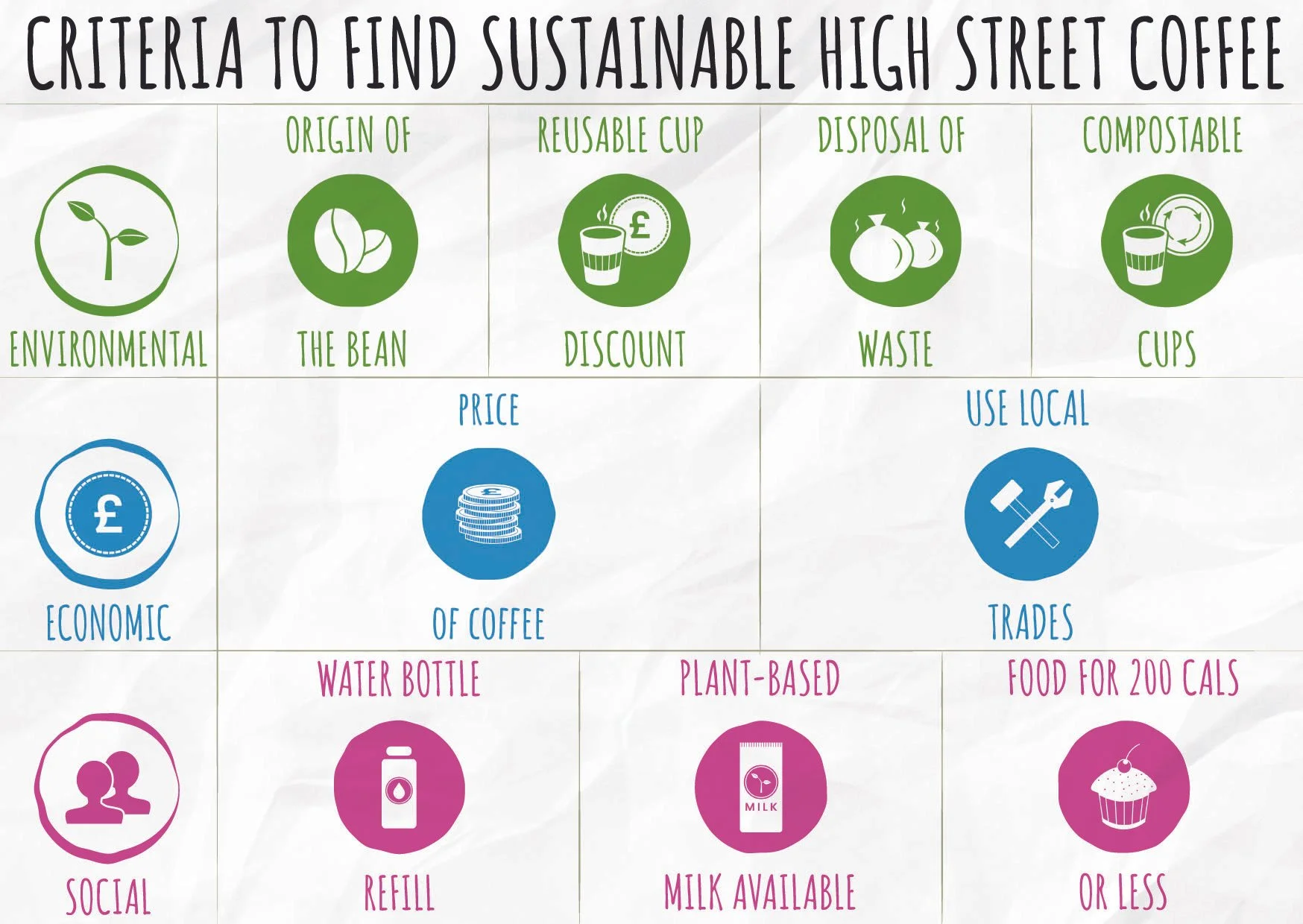
This table summarises the criteria: the questions we asked and how we tested sustainability
The research involved visiting and surveying 30 establishments in and around Govanhill. Our research extended beyond the high street, to ensure we were testing the practice of some of the non-high street players too which may have to try harder to attract customers.
We bought a coffee at every establishment surveyed, and we took the answers the staff gave us on the day. If the staff don’t know how the food waste or coffee grinds are disposed of, or if they are allowed to fill up a water bottle, that can be seen as an action for management to review staff training.
After testing over 30 takeaway coffees over a number of weeks – some on Victoria Road and others in Strathbungo, Pollokshields and Mount Florida – we crunched the numbers. The findings were interesting, with the most expensive takeaway coffee at the time of testing £3.90 and the cheapest £1.99 – nearly half the price. The average price of a coffee we tested was £3.29.
It was interesting that it was not the most expensive coffee shops which ranked highest on our sustainability ratings and some of the cheaper options did better. For example, Gusto and Relish and Fulton’s both offered coffee under £3 and ranked in our top ten. They were both noted for their responsible approach to disposal of organic waste.
Peachy and Cibo both sold good value takeaway coffee and also offered a further discount for using your own reusable cup. Half of those tested did give a discount for reusable cups, so it is worth carrying a cup on you.
Café Buena Vida and Jeju Bakes on Victoria Road, as well as Portal Café near Govanhill Park were all good value and offered composable cups. McDonald’s, the cheapest out of all the establishments we checked, also offered a cup made from plant material. Look out for takeaway cups labelled Decent or Vegware – brands made with sustainability in mind.
While some of the chain establishments had put a lot of thought into sustainability of the bean and the cup, we found with Sainsbury’s, Greggs, McDonald’s and Starbucks, their contribution to the local economy was limited to employing staff rather than using local trades and sourcing local products. Many independent coffee shops were great places to find out about local window cleaners, electricians and joiners.
Most establishments were vegan friendly and offered different types of plant-based milks – with Starbucks offering the most options. Some, like Locavore, also used dairy milk from local farms. While over half the establishments displayed the origin of their coffee for customers. Thompsons and Dear Green are the two most popular coffee suppliers locally and it is easy for interested coffee drinkers to follow on Instagram to find out more about the origins of their coffee.
There was a lot of variances with disposing of waste. The staff in two places were unsure of how waste was disposed of while all the rest had a commercial contract in place. Chains often have their own arrangements. If over five kilos of organic waste is produced a week, the organic waste should be separated from the main waste stream and disposed of in different bags, yet only half of the establishments we spoke to separated organic waste. It was great to find out there is a special collection by a local community group of coffee grinds for some participating shops on Victoria Road such as Patricia’s and Crema.
Many of the places with the most expensive cups of takeaway coffee didn’t offer any food options under 200 calories, meaning customers had no healthy options. Both Sainsbury’s and Locavore offered fruit to grab on the go with a coffee. It can be difficult to gauge calorie content of many snacks, which is why it is now mandatory for larger organisations to display this information in England and Ireland.
Hydration on the move is important to keep healthy and we found that all but four establishments were willing to fill up water bottles. This is now a requirement for hospitality venues which sell alcohol, so we were glad to see most coffee shops offering it as well.
This is not a definitive list, but we hope this exercise will empower Southsiders to ask questions about the food and drink they are purchasing and consider trying somewhere they haven’t been before. We are lucky to have so many takeaway coffee outlets to choose from and, as time passes, the kaleidoscope will turn again and a new array of offerings will be available on our high street.
We hope that sustainability will be part of that story.
The top five places selling takeaway coffee who we found to be strong on our sustainability criteria were:
Locavore
Café Buena Vida
Gusto and Relish
Sunny Acre
The Grind House
South Seeds was delighted to receive a grant from the Royal Society of Edinburgh to complete this research.
We hope that it may encourage other high streets in Glasgow and in other cities to consider surveying takeaway coffee establishments.
We would be very interested in any public reaction to this attempt to create real workable standards/criteria of sustainability for a product that many residents purchase, even if only occasionally.