Who has the right to urban land?
As urban spaces like Mount Florida Bowling Club are bought to build private rentals, communities lose access to green spaces. Community Right to Buy is one way communities can reimagine belonging in urban spaces through community ownership. But one writer's research highlights deeper concerns of how the land reform movement leaves some communities feeling they don’t even have the right to be in public spaces.

Campaigners fighting to save green space surrounded the former bowling club
By Yasmine Rahemtulla | Photos by Nicola Smith
My neighbourhood, Mount Florida, is known for being home to Hampden, Scotland’s national football stadium, but there’s nowhere for local people to meet up without having to pay for a coffee or a pint. There’s also a lack of green space in the area now that Cathkin Park has been fenced off.
In fact, many of the streets here don’t meet Glasgow City Council’s Open Space Strategy 2020 policy – that homes should be within 400m walking distance of ‘good quality, publicly usable open space of 0.3ha or more’.
But until recently, we did have one potential community asset; Mount Florida Bowling Club. The space has a large piece of green land and a building with toilets and a kitchen – facilities that would be perfect for our community to get together.
The club was closed down in 2019 due to dwindling membership and was never advertised for sale before it was bought in 2021 by Noah Properties, a property developer with plans to build flats on the site. For the past six years, Mount Florida Community Trust has been trying to save the land from development – hoping to buy it for the community.
I joined a small team of volunteers supporting community engagement around the site. We spoke with local people to raise awareness of the plans and understand what people actually wanted from the space. This included spaces to grow food and places for children to play.
But, despite our efforts, planning permission to build over the site was granted at a hearing in September this year.
Rising costs are forcing people out of Mount Florida and, in 2023, Glasgow City Council declared a housing emergency. However, none of the 32 new homes by Noah Properties on the former bowling club site will be social housing. Described as “bespoke”, these homes are unaffordable for most locals and won’t help families stuck on long waiting lists.
The legacy of bowling clubs
Bowling clubs were once central to local life, but many had exclusionary histories and much of the wealth that built these clubs came from the empire. Today, many are closing because of falling membership, but they still hold huge potential. When opened up and reimagined for everyone – as community hubs, gardens or event spaces – they can transform from symbols of exclusion into places of belonging.
Less than two miles away, Bowling Green Together is hidden behind tall hedges on Kenmure Street in Pollokshields. This was the site of Kingswood Bowling Club, which lay abandoned until local people cleared the site and transformed it into an essential community green space during lockdown.
Bowling Green Together hosts culturally affirming events that celebrate diversity and community solidarity – from marking India and Pakistan Independence Day together to welcoming everyone, including non-Muslims, to community iftar meals. Beyond these events, the space itself has been an instrumental point of connection and was an important part of the neighbourhood resistance to the dawn raids on Kenmure Street.
Protected green spaces matter, especially as public parks and streets are becoming less safe for Global Majority people in the UK. The community garden of Bowling Green Together hosts gardening sessions exclusively for people in the asylum system or who are refugees, along with weekly public sessions.
Martha, one of the gardeners who facilitates these sessions sees her work as facilitating connections between different people, but also facilitating relationships between people and plants. She explains: “Community ownership of that common ground is so important because when you get people together who speak different languages, who are from different countries, who have different religions, different political views, a garden or a growing space is an amazing place for people to meet and make connections.”
The feeling of ownership over a space, and legal ownership are two very different things. To begin the process of legal ownership, you need to feel you have the right to be here in the first place. As Martha says: “Who feels they have the right to land? If you have any migration in your heritage, that feeling of right is complicated.”
When communities take back space
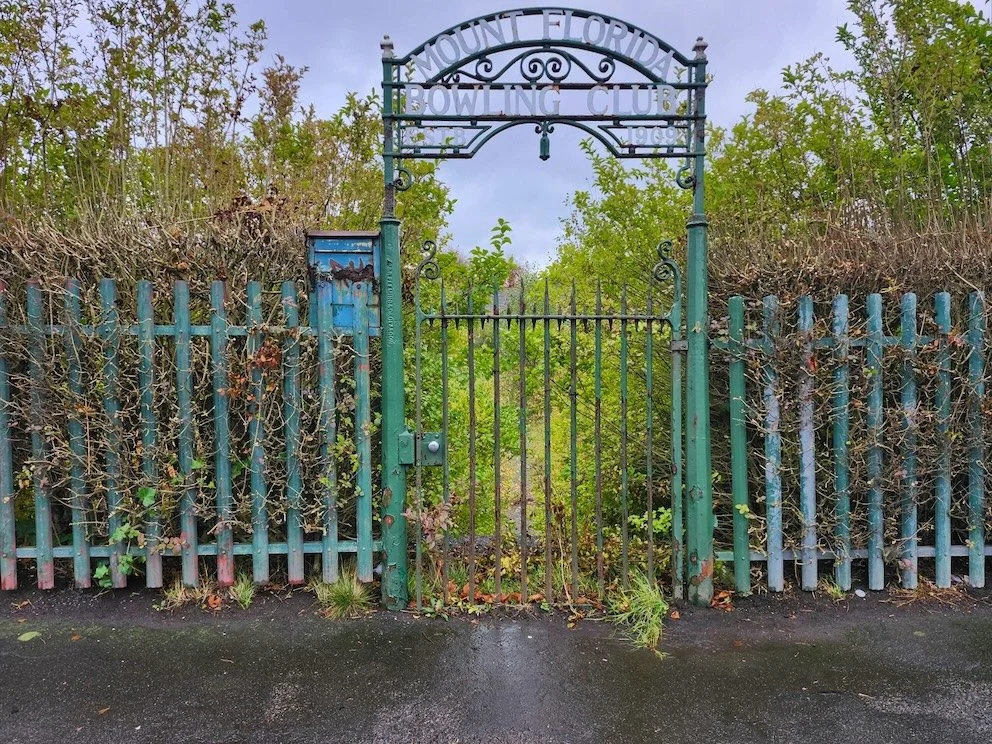
Mount Florida Bowling Club
When Mount Florida Bowling Club was sold to a developer, it became almost impossible for local people to keep it as a community asset. The Community Right to Buy can’t be used to stop developers, but there is a way to protect local spaces before they’re sold – registering community interest in land.
Registering interest (known as Community Right to Buy Part 2) means a community must be offered the chance to purchase land or buildings before anyone else for up to five years. This process helps protect valued spaces and gives communities time to act. Yet for many local organisations, registering interest feels like a luxury. They have more urgent responsibilities and can only save a space once it’s under threat. And at that point, it’s often too late.
In 2022, only five of the 258 registered interests came from Scotland’s 20 percent most deprived areas. That means the communities most affected by poverty and lack of green space are the least likely to benefit from the policy designed to help them.
According to Community Land Scotland, Global Majority groups also face barriers to community land ownership, and ‘not recognising Scotland’s history with slavery and imperialism, and its impact on landownership, affects policymaking and people’s lives today.’
Over a four-month research project, I explored reciprocal connections to land in my neighbourhood and through participatory methods developed the idea of ‘Sanctuary Spaces’ – as a way that Community Right to Buy can be a powerful way for urban communities to protect green spaces in the city, which in turn protect marginalised people.
My research found a deeper issue too: a discomfort with the very idea of “ownership” itself, and concern that the language driving the land reform movement doesn’t resonate with communities who may not feel they have the right to even be in public spaces, let alone own them.
Over the summer, I explored what “ownership” really means in urban spaces, especially for Global Majority communities who are currently excluded from land movements in Scotland. I wanted to reframe ownership in a way that felt relatable to people living in cities.
Why this matters now
We’re losing community spaces: between January 2020 and December 2024, Scottish councils sold off 1,851 schools, community centres, halls, properties and other land. Although some services become more efficient online, when we lose places where we can meet people outside our existing social circle, division and isolation creep in.
Registering Interest is the most effective route, and in places like Glasgow’s Southside, there are lots of groups that are well-placed to do this work.
At the moment, this work is being done voluntarily by a handful of people, but the outcome of my project is to connect these groups to identify a local space at risk of closing – like a bowling club – and work together to register interest. This means that we avoid losing our green spaces, and can protect them before they are bought.
There’s a need to build a visible ‘culture’ of community ownership, where communities can see the benefits and learn from others. Global Majority communities must be centred in this, as they face the greatest barriers and are often excluded from land movements. There are already examples of the focus shifting from nationalism to land justice, recognising Scotland’s colonial history and avoiding cycles of hierarchy and domination.
Community Land Ownership exists, but it must actively reach into the communities who need it most – especially working-class and Global Majority groups – and be led by their hopes and motivations for land justice, if we want to see real change.