Why do evictions keep rising in Govanhill? We dug into the data to find out
Why are eviction notices rising and legal protections falling short, it’s leaving many tenants in Govanhill fighting to stay in the neighbourhood they love? Living Rent member, Ruby Dark, dives into the topic further, speaking to those affected.

Photos of letting sign in the Southside
By Ruby Dark, member of Living Rent | Data visualisation by Laura Hurst | Photos by John Bowden
For some, Govanhill is becoming the face of gentrification in Glasgow – seen in the changing shop fronts on the high streets and in rising property values. It is also evident in the increasing cost of rent in the private rental sector.
Recently, a studio flat on Dixon Avenue was advertised on Zoopla at £1195 a month. That’s £275 a week for the privilege of sleeping an arm’s length away from your kitchen sink.
While the Govanhill Housing Association and Southside Housing Association do offer social housing options, the scarcity of affordable properties creates insecurity for many. People are being pushed out of the neighbourhood, detached from their communities, and left to fend for themselves without a safety net.
What is a Section 11 notice?
To lawfully evict a tenant, a landlord must raise a Section 11 notice with the council. This is to give local authorities notice of tenants who may be at risk of homelessness, so they can offer necessary support. Although GCC does not record the reason such notices are served to them (such as rent arrears, intent to sell the property), the council do record the total number of notices received.
In some circumstances, this leads to people being evicted from their homes. This brutal process upends people’s sense of security, forcing them to leave their homes, and putting them at risk of homelessness.
Data obtained from Glasgow City Council (GCC) via a Freedom of Information request reveals that more and more tenants in our neighbourhood are facing eviction.
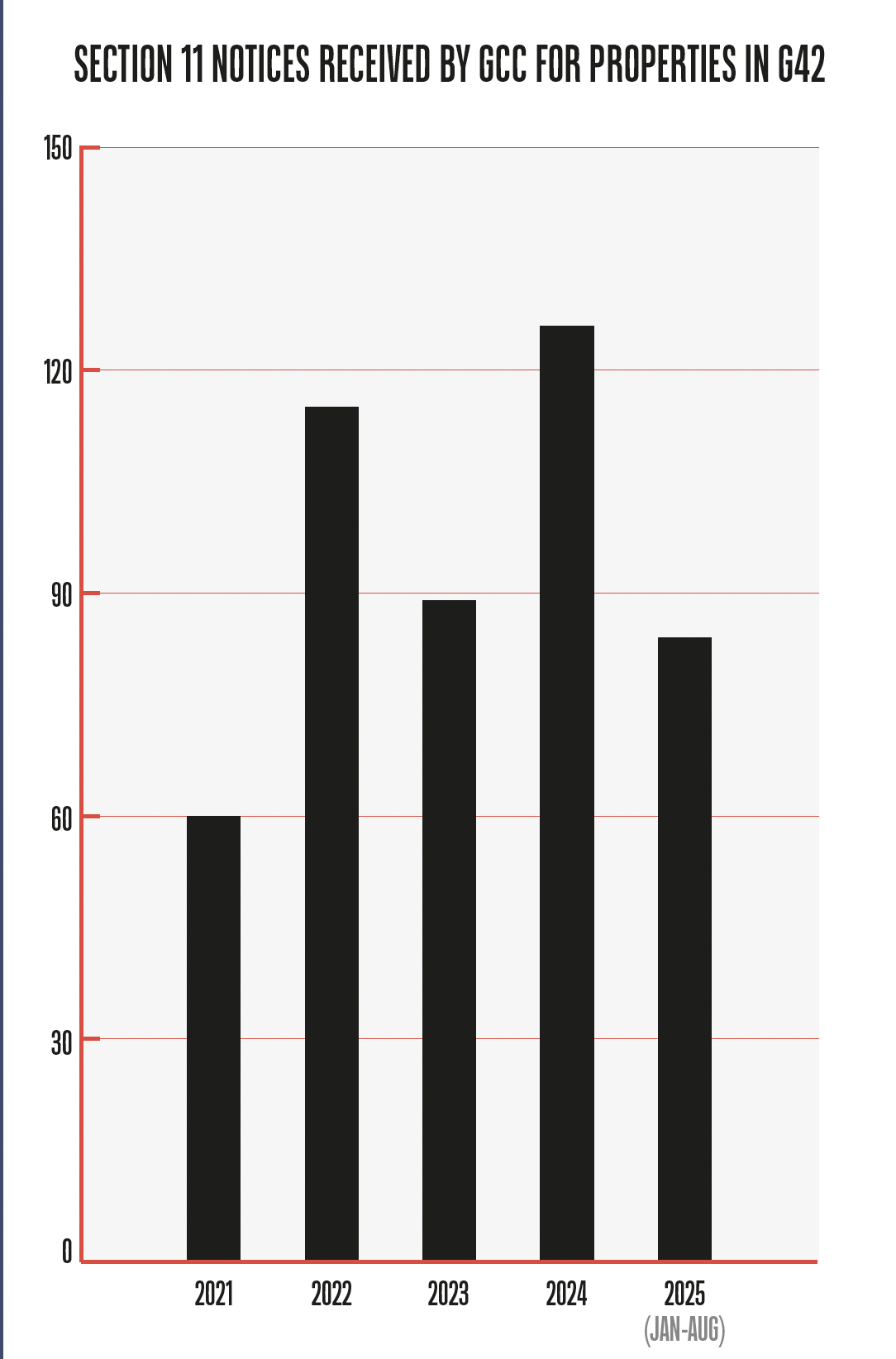
It shows that in 2021, GCC received 60 eviction notices for properties in the G42 postcode. This almost doubled to 115 in 2022. The figures dipped slightly in 2023, to 89. This reflects the temporary protections afforded in the Cost of Living (Tenant Protection) (Scotland) Act, which came into force in October 2022 and lasted until April 2024.
The Cost of Living Act placed a suspension on evictions and introduced temporary rent caps to stabilise housing costs and give tenants more security in the midst of the cost of living crisis. But landlords could still proceed with evictions in certain cases. For example, in the case of rent arrears, criminal damage, or financial difficulty.
The data shows that the protections offered by the Cost of Living Bill had a limited impact in Govanhill. The council received 89 notices in 2023, still more than in 2021.
Saif’s story
Saif loves where he lives in Govanhill, which he moved to in 2020. Speaking about that arrival, he said: “It was like a new beginning, it was quite blissful. It has a garden and I’m near the park. It was just perfect for my mental health. It felt like I could breathe for the first time.”
But after some months in the flat, Saif’s living conditions started to worsen. The boiler was faulty and he noticed rats in the flat: “Problems started to appear and [the landlords] never dealt with them comprehensively. The last straw for me was when the lock on the door broke during winter, so anybody could walk through.”
In 2020, Saif took his landlords to tribunal for failure to complete repairs. He was awarded a 40 percent rent reduction. But shortly after, he was served a notice to leave the flat. The reason the landlords cited was rent arrears. After paying the arrears, in 2022 the courts determined that Saif was allowed to stay. But his ordeal didn’t end there.
Saif was served another notice to leave almost immediately. This time, the landlords cited financial hardship as their reason to evict Saif. But due to Cost of Living legislation in place at the time, they had to meet additional requirements to prove this. The case went to court, and after months of fighting, Saif successfully appealed the eviction.
As soon as the bill expired, Saif’s landlords gave him another notice to leave, citing their intent to sell the property due to their own financial hardship. This time, they didn’t have to submit as much evidence and the courts granted the eviction notice, leaving Saif without a home from October this year.
“Five years on, none of the repairs have been done. Psychologically it’s been a lot for me. I want to stay here. My landlords might be facing financial difficulty, but I’m losing my roots, my community, my familiarity.”
Clearly, legislation is falling short of protecting tenants. The data shows that in 2024, GCC received 126 eviction notices, the highest number since 2021. And this year is on track to at least meet that number – from January to July 2025, 84 notices were received, more than the entirety of 2021.
The data paints a picture of a growing problem – and it only includes official notices received by GCC. Many landlords don’t follow the legal protocol.
Matty’s story
Student and DJ, Matty, was served a notice to leave his flat in Govanhill last November, because his landlord was selling. He was given three months to leave: “I had to be out by the end of February…I was just worrying about what I would do when Christmas was coming.”
Matty’s landlord didn’t serve an official eviction notice, but there wasn’t much he could do to fight back: “My landlord lived in Berlin. If she lived locally or in Scotland, I could take action with Living Rent to pressure her to give us more time…it wasn’t feasible.” Since his flatmate found a place already, Matty had to leave the flat as well, or end up paying twice the rent.
It was difficult to find another suitable flat in Govanhill, and he had to leave: “It took a real mental toll on me…it also put stress on my relationship.”
People are being pushed further into poverty than before, unable to afford their rents, being forced out of their homes by landlords who want to cash in on rising property values.
Why are tenants so vulnerable under the current system?
Our neighbourhood has seen huge increases in property prices. Data from OnTheMarket shows that, as of September 2025, the average price for a home in Govanhill is £183,000. That’s a rise of 10.9 percent in the last 12 months.
Zooming in on individual property prices shows astronomical increases in some cases. Property listing data on Rightmove reveals that on Dixon Avenue, a second floor flat was bought for £82,500 in March 2021, only to be sold for £178,000 in March 2025. That’s a 116 percent increase in just four years.
These trends incentivise landlords to sell up and make a profit, feeding into a vicious cycle of rising rents and a lack of affordable homes. Housing is positioned as a failsafe investment to play on the market, a pot of money for tenants to temporarily keep warm – not a social necessity.
So how do we repair this broken system?
In September, Holyrood voted to pass the Housing Bill, re-introducing rent controls in Scotland and giving councils the power to cap rent to inflation level in certain neighbourhoods.
Padraig Durnin, Campaigns Officer for Living Rent Govanhill, said this bill: “Is the biggest victory for Scottish tenants in several generations. For the first time in over 40 years, the majority of private tenants will have permanent protection from capricious rent increases.”
The bill also sees new protections introduced for tenants facing eviction. Tribunals will have greater scope to delay evictions where tenants are vulnerable and implement higher damages for wrongful eviction. But certain amendments aimed to protect tenants further were voted down. “The SNP rejected efforts to amend the bill to reinstate the winter eviction ban which we know kept families from being thrown onto the street in freezing temperatures,” Durnin said.
Living Rent campaigned for years to put rent controls back on the political agenda but their work doesn’t end here. They’re campaigning to close loopholes in the bill and extend protections offered to tenants. Durnin said: “We need to see the government urgently revisit the loopholes in this bill exempting build-to-rent and ‘mid-market-rent’ properties from rent controls.”
Living Rent organise locally to defend tenants facing eviction. They also organise nationally to extend meaningful protections to tenants in government policy. It’s easy to feel powerless if you face housing insecurity alone. But if we organise together, we can put power back in public hands. We need to redefine the housing market towards working for the public rather than rewarding private interests. The Housing Bill is a step in the right direction.
What are my rights around eviction?
Your landlord must give you written notice explaining why they want you to leave and when.
If something doesn’t feel right, you can challenge the eviction.
You don’t have to move out unless a housing tribunal says so – they need an official eviction order.
The notice period is usually 4 or 12 weeks, depending on how long you’ve lived there and the reason.
Find more info at shelterscotland.org or join Scotland’s tenants’ union via livingrent.org