Why were cricket and rugby absent from Glasgow’s Commonwealth Games?
Rugby sevens and cricket didn’t feature at Glasgow 2026. Their absence is understandable given the Games' reduced programme – but it also removed two sports whose histories are deeply intertwined with the British Empire.
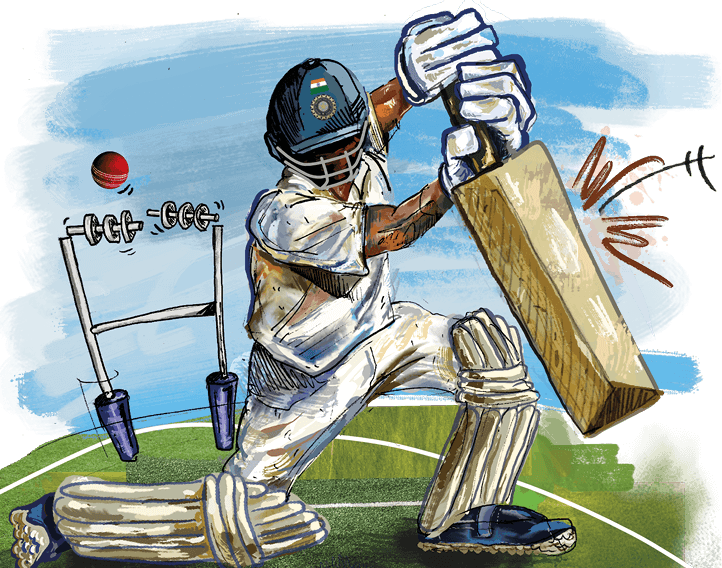
By Kate Fry | Illustrations by Alastair Quietsch
As Glasgow hosted the 23rd Commonwealth Games this July, two sports remained conspicuously absent: rugby sevens and cricket.
The exclusion of some sports from the Commonwealth Games programme is not unusual in and of itself. Unlike other major multi-sport events, the Commonwealth Games boast a flexible sporting programme, and host cities can pick-and-choose which of the approved 23 sports and ten para-sports will be on offer. This flexibility allows cities to tailor the games to their unique infrastructure and circumstances.
Because Glasgow stepped in to host the 23rd Commonwealth Games on an emergency basis, this particular programme was especially reduced: it featured only ten sports, the smallest number since the 1994 Games.
A Commonwealth Games spokesperson told Greater Govanhill these special circumstances had played a key role in the scaled-down programme: “Given a condensed budget and delivery timeline of 18 months, it was[...] important to consider how we could most efficiently use Glasgow’s existing venues, manage the total number of athletes and minimise the risks and uncertainty of legislative or planning complications.”
“We know how much the Commonwealth Games means to athletes and sports, so we naturally understand that sports which aren’t included will be disappointing.”
Yet, the choice to prioritise other sports over cricket and rugby still raises questions. These are sports which are not only extremely popular amongst Commonwealth countries, but also the two sports which are perhaps most enmeshed with the history of the British empire – a history which the Commonwealth Games are under increasing pressure to reconcile with.
The colonial history of rugby and cricket
The Commonwealth Games began life in 1930 as the British Empire Games, and their history remains closely tied to Britain’s imperial past. While Glasgow 2026 has acknowledged that legacy elsewhere in its cultural programme, the absence of rugby and cricket means two of the sports most closely associated with the spread of empire will not feature in this year’s competition.
Amidst these conversations, Glasgow’s decision not to offer cricket and rugby feels all the more like a missed opportunity to engage more meaningfully with the event’s colonial legacy.
It is, after all, impossible to talk about the history of either sport without talking about the British Empire.
Early versions of cricket were widespread in Britain and Ireland as early as the Medieval era, and by the 18th century it was widely regarded as England’s national sport.
As the British Empire expanded in the 17th and 18th centuries, British settlers and slavers brought the game with them to the colonies, where it gained particular popularity in South Asia and the Caribbean. The oldest surviving artefact depicting cricket outside the British Isles is the Barbados Cricket Buckle, an engraved belt buckle depicting a bound slave holding a cricket bat dating back to the late 18th century.
Though its roots in football also span back to the medieval era, rugby was only formalised in 1845 and did not spread outside of Britain until the latter half of the 19th century.
Arriving first in South Africa in 1862 and then in New Zealand and Australia throughout the 1870s, rugby too would primarily be spread by settler-colonists.
Like Christianity and the English language, the British saw both cricket and rugby not only as a means of culturally assimilating the indigenous peoples of their colonies, but also communicating ideals of white, Christian masculinity. Notably, rugby owes its popularity with the Māori people of New Zealand in part due to a colonial ban on the indigenous sport of ki-o-rahi, a fast-paced ball game. This sport was banned by Christian missionaries, who were suspicious of its connection to Māori spiritual beliefs.
Rugby and cricket clubs were often sites of racial segregation in several countries up until the 1960s, when the South African team’s apartheid policies began to affect their international reputation. In 1990, in a statement now known as the “cricket test,” the former Tory politician Norman Tebbit made the accusatory declaration that any immigrant or descendent of South Asia or the Caribbean living in the UK who did not support the English cricket team had failed to successfully integrate.
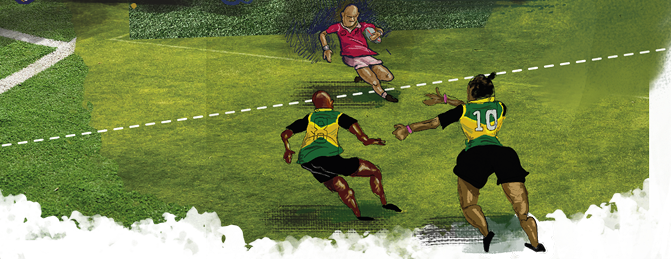
Reckoning with the past
While cricket and rugby have continually found themselves the sites of imperialism and white supremacy, they have also undergone postcolonial transformations, sometimes even becoming sites of liberation or resistance.
In 1963, the Trinidadian writer and Marxist C.L.R. James wrote of cricket: “I haven’t the slightest doubt that the clash of race, caste and class did not retard but stimulated West Indian cricket. I am equally certain that in those years social and political passions, denied normal outlets, expressed themselves so fiercely in cricket (and other games) precisely because they were games.”
For many of the colonies, matches against England offered a chance to dismantle colonial narratives of white superiority. Until 2019, the English had never won a cricket World Cup and predominantly non-white teams such as the West Indies, India, Sri Lanka, and Pakistan dominated the early years of the competition. In 2018, the International Cricket Council reported that over 90 percent of the sport’s estimated 1 billion fans are located in the Indian sub-continent.
That popularity is visible much closer to home. Many Southside residents will have seen the large cricket matches that regularly take place in Queen’s Park, particularly among the area’s South Asian communities. Local charity Active Life Club also offers weekly cricket skills sessions for young people, reflecting the sport’s continued importance in Govanhill and the wider Southside.
The contemporary status of the sport is perhaps best summed up by the infamous first line of Ashis Nandy’s The Tao of Cricket: “Cricket is an Indian game accidentally discovered by the English.” While India is not the only nation on the Indian sub-continent, or the only colonised nation, to have connected with cricket, the sentiment that the sport’s English origins have become lesser than its post-colonial rebirth will resonate with many contemporary fans.
Likewise, rugby’s colonial history has been complicated by the role of indigenous people in the development of the sport. The New Zealand national rugby team, the All Blacks, owe much of their success to the influence of the Māori people and their unique “ball-passing” style. Since the late 1880s, the All Blacks have maintained the tradition of performing a Haka – a Māori ceremonial challenge – before matches.
When asked about efforts to recognise or address the violence associated with British colonialism, Phil Batty, CEO of Glasgow 2026, said that the Games: “Create a unique space to talk about social injustice, historical inequality, decolonisation, the identity of individual nations and the history those nations have had and how much change there has been since the Games began 96 years ago.”
Two key pieces of that history were absent from the Games this year. However, their omission may yet only be temporary. A spokesperson for Glasgow 2026 stressed that the sport selection for this edition was shaped by the exceptional circumstances of staging the Games at short notice and would not influence future programmes. With Delhi set to host the next Commonwealth Games, cricket is expected to make a return.
