Exploring cultural identity through food
Sadia Sikandar’s latest photography project, Stories of Food and Belonging, earned international recognition at the World Food Photography Awards. In this interview, writer Margot Leys speaks with the artist about her work, the challenges she has faced as a hijabi, and how food can be a powerful force for connection in a time of growing division.
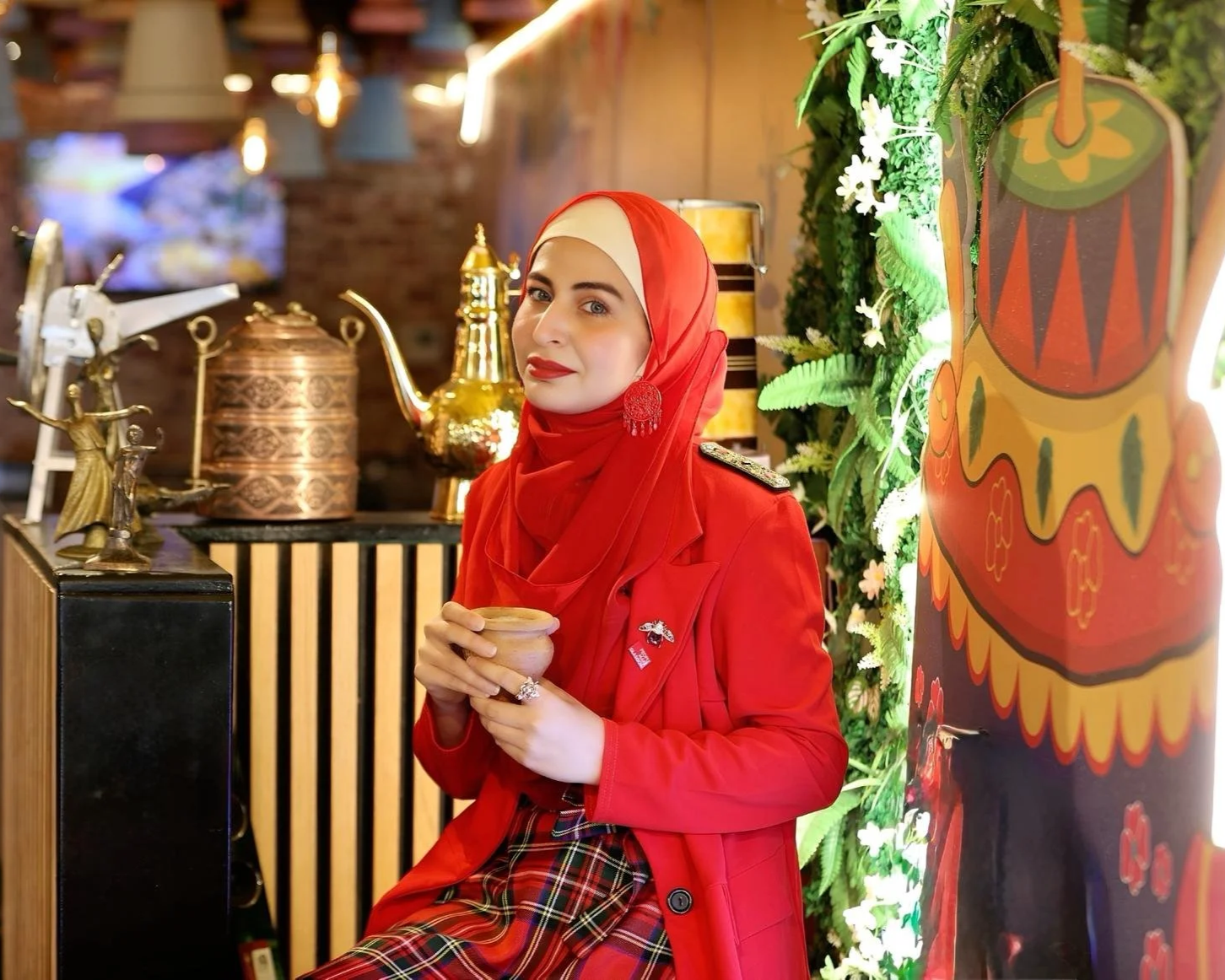
Sadia Sikandar
By Margot Leys | Photos by Margot Leys and Sadia Sikandar
Sadia Sikander is a photographer, a journalist and an activist. Her latest exhibition, Stories of Food and Belonging, which won international recognition at the World Food Photography Awards, explores cultural identity through food. It features a series of portraits of people living in Glasgow who are seeking asylum, or have recently received refugee status. Each portrait shows the subject with a meal from their home country, and is accompanied by an explanation of what that meal means to them.
I spoke with Sadia on the day of her exhibition opening, which coincided with a protest on Buchanan Street organised by Stand Up to Racism (SUTR). This had been hastily organised in the wake of an anti-immigration protest that took place in the city centre earlier that week, following violent far-right disruption in Belfast.
Read more: Greater Govanhill contributor Sadia Sikandar wins international photography award
I met Sadia at the top of Buchanan Street, where she was taking photos of the protest for SUTR (she is also on the board for the activist group). I found her engrossed in conversation with people she had just met, speaking as though they were old friends. Naturally sociable and chatty, with an infectious smile, it’s hard not to fall into an easy discussion with Sadia.
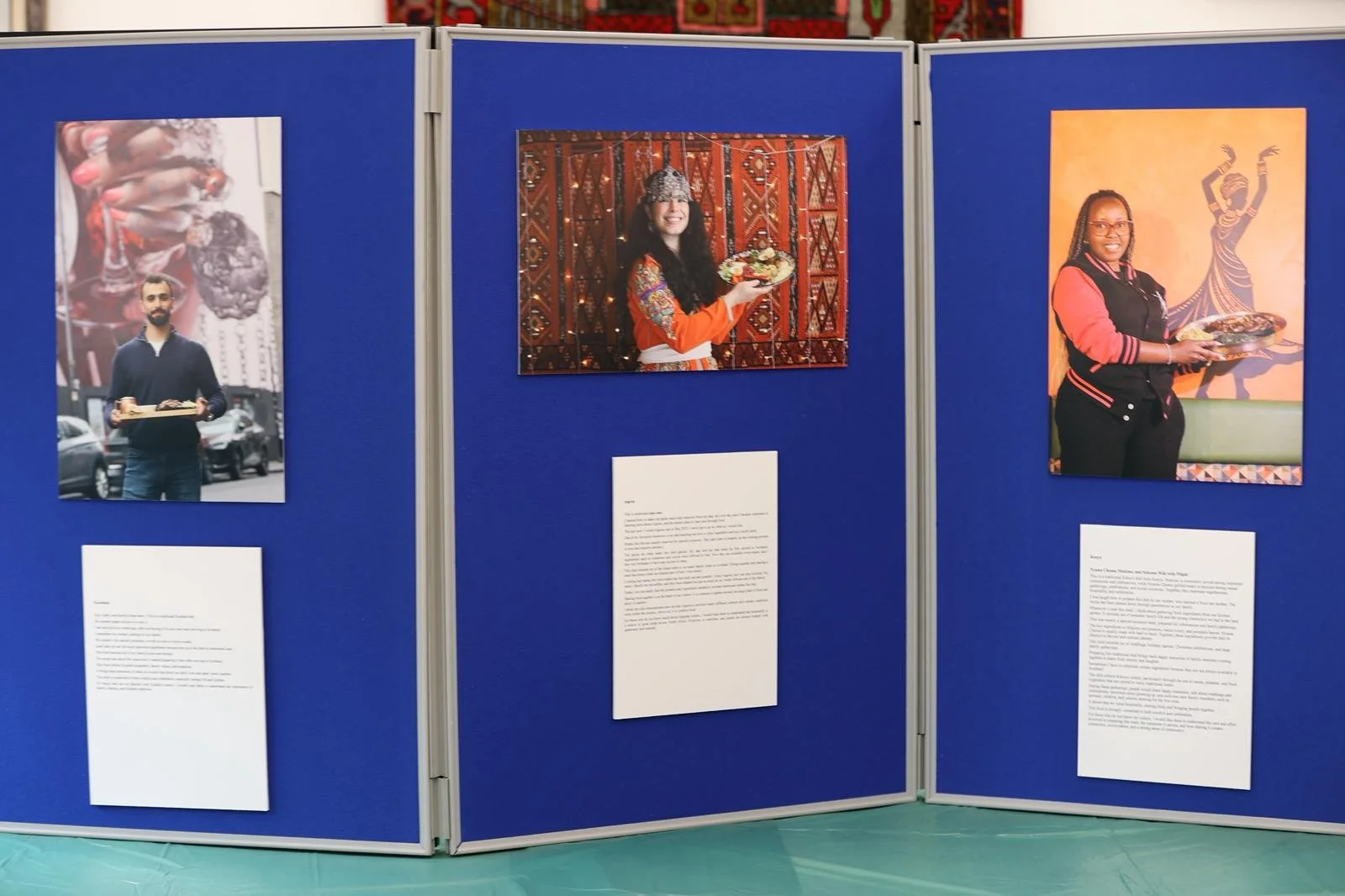
Photos included in Sadia’s exhibtion
As the protest drew to a close, Sadia and I got a taxi back to her exhibition. She’d begun the day setting up her photos in the exhibition space, the cafe Coffee and Zkir on Niddrie Road, then headed into town to join the protest. Having known Sadia for a little over a year, I’ve come to expect and admire this ability of hers to be constantly on the move. She has an endless capacity to show up, work hard, and stay motivated.
In the taxi, she tells me that she sometimes struggles to feel appreciated in activist circles. As a muslim woman who wears the hijab, she cannot hide her background or religion in the way she notes her male counterparts can. She is more visible and thus more exposed to discrimination, yet feels that she does not receive support for this. If anything, she says, the same groups that are supposed to be pushing for her representation are the ones marginalising her voice by platforming other, more established artists.
When we get to the exhibition venue, Sadia’s mood picks up. Some volunteers who feature in her photos were keeping an eye on things so Sadia could attend the protest. While she was away, a man had come into the exhibition who was from Yemen, where two of the volunteers were born. A fast friendship had evolved, and Sadia was beaming as she watched them all get into the same car when they left.
Sadia tells me that “through this exhibition, a lot of conversations can start happening”. By sharing stories of food, “people find common ground” and can more easily connect with other people’s cultures.
The idea came from the community meals she runs with her charity, Seham & Najma, which provides a free weekly dinner for asylum seekers living in hotels. Sadia provides the ingredients and venue for someone living in the hotels to cook a large family style meal. It was important to Sadia, who herself arrived in the UK from Pakistan as a refugee, that those living in hotels get a chance to have access to a kitchen and eat food from home.
The meals were culturally diverse, and Sadia began asking questions about what was being cooked and why the dish had been chosen. Through these conversations, Sadia felt “more connected with their culture” and realised the power food has to bring people together.
Over three months, Sadia invited participants from these community meals, or people she knew from other campaign groups living in hotels, to “cook something from your country and tell me about them”. In some of the photos, the person is wearing traditional cultural clothes whilst they hold out the meal they prepared, as though they are offering a bite to the audience. Sadia explains that some people were not able to bring their cultural clothes when they left their home countries, or have not been able to build up a network so they could borrow some from here.
Sadia wants the exhibition to help people know each other’s culture. This way “they can understand any mutual connection from their culture to us, so they have a reason to respect us”, Sadia tells me. The “they” she refers to is white Scots. I ask her if she feels a responsibility to encourage understanding on behalf of her community. She shakes her head: “it is not a responsibility; it is necessarily important”.
The past couple of years have seen a rise in racialised hatred and anti-immigration propaganda. The attacks on homes of migrants in Belfast on Monday 8 June were yet another example of the hatred towards people of colour that has been simmering in the UK.
Sadia wants to use this exhibition to highlight how much migrants and non-migrants have in common. We all enjoy food, and we all have a meal that holds significance to us. She explained to me that the majority of the people coming into the exhibition that day were white. She was proud to see conversations about food and culture beginning, pointing to one piece of feedback written in the comments book: ‘I can’t wait to go home and cook these meals!’
Read more: Rumi’s Cave: Sufi traditions at new Coffee & Zikr cafe on Niddrie St
This cultural sharing goes both ways, Sadia tells me. When she was growing up in Pakistan, Sadia always saw the tartan pattern. Her father used to wear the pattern a lot, as well as musicians she would see perform. It wasn’t until she came to Scotland that she found out it was originally Scottish; she thought it was born out of her own Pakistani culture. Sadia was fascinated by this history of tartan she never knew about, and it made her feel more connected to the country that was becoming her new home. Ties between Pakistani and Scottish culture are so strong, she tells me excitedly, that a Pakistani inspired tartan was designed recently that incorporates the blue and green colours of the Pakistan flag.
In the small hours of the next day after Sadia’s exhibition and the protest, Scotland played their first World Cup match against Haiti. As I left the exhibition venue in the late afternoon, every pub was already filled with people in Scotland colours even though the game wasn’t for another several hours. Regardless of race, religion, ethnicity, politics, the city was coming together to share the excitement of Scotland’s return to the international football stage.
Despite all the violence and divisiveness, people were finding common ground. “Respecting each other is more important than anything else”, Sadia says to me. All the work she does reiterates this message, encouraging people to look beyond skin colour and prejudice to form community and be accepting. Whether through food or football, there is a lot more similarity than difference amongst us, once, like Sadia, you stop and look for it.
