Govanhill, Whit Aboot Yae?: The heart ae Scots isnae wits in a dictionary, it’s in the people who speak it.
Walk down Victoria Road on any given afternoon and you’ll hear it – that sharp, melodic rhythm of Glaswegian Scots ringing out between the fruit stalls and the coffee shops. It’s the sound of our neighbourhood, yet for generations, many were sold a lie: that this way of speaking was merely ‘bad English,’ a habit to be ditched from the tongue at the school gates.
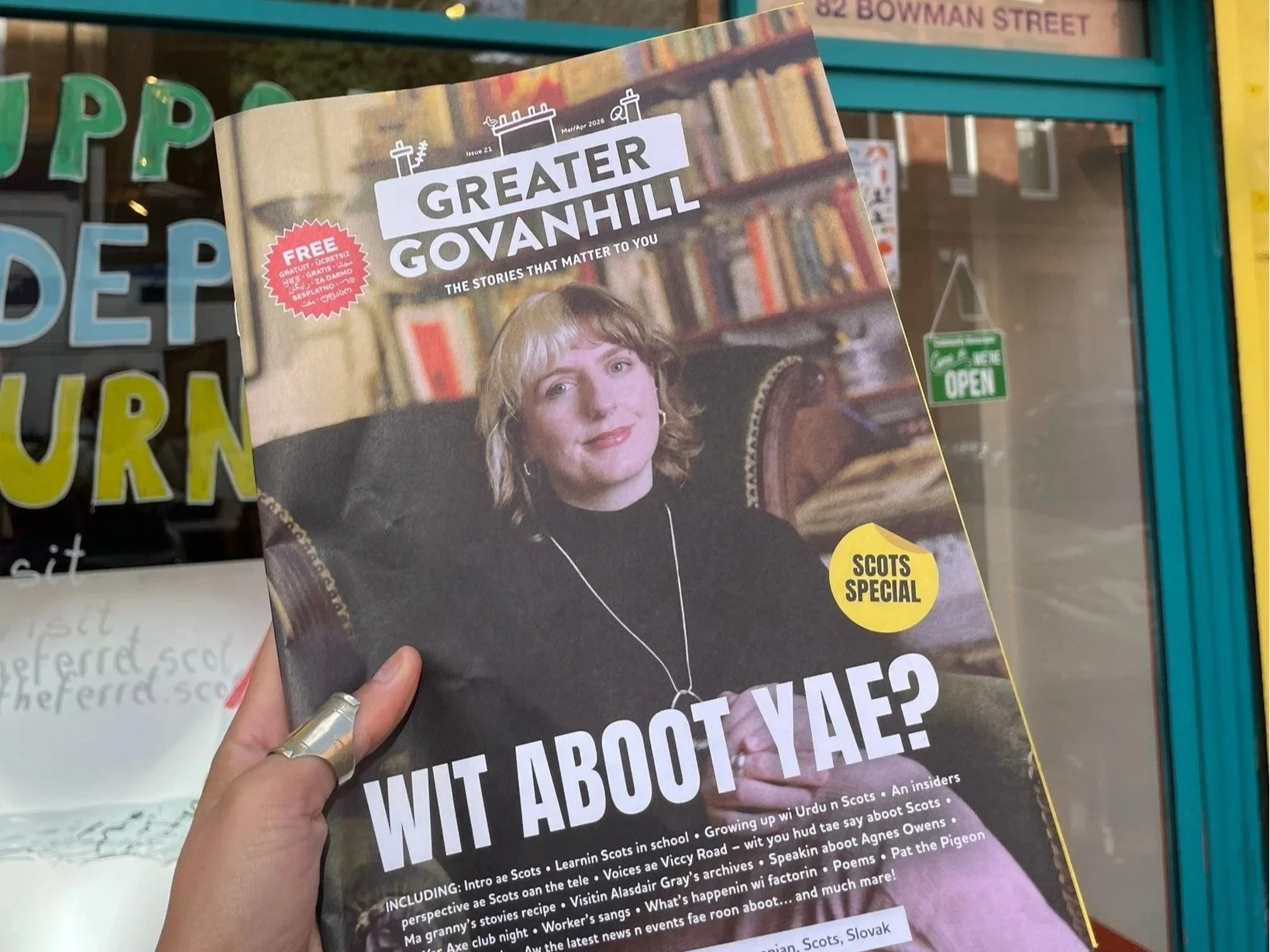
By Mikael Phillips | Image by Samar Jamal
In this 21st issue of our Greater Govanhill Magazine our writers reflected on the big questions: How do you define the Scots language? What actually makes a Scots speaker? In a nation where there are countless variations in language – from Doric and Gaelic to Shetlandic and Dundonian – it raised the question: what is the newly recognised Scots language? This question became the footing for our endeavour into creating a Scots special issue, which has been making its way across the Southside this past month.
“You don’t realise that all of these things that you’re saying are actually Scots.” Andrew Conlin
For years before co-editing this magazine, I had been writing my own plays, short stories, and the odd poyum in Scots, but – and this is coming from the person who wrote them – they were absolutely abysmal back then.
My journey into Scots scrievin started around 2016 in my second year of uni, writing wee plays and lyrics to garageband tunes... again, abysmal. I kept it quiet and personal because, by that point, I’d spent 18 years in an education system that was essentially squeezing my Scots identity out of me. From the age of 12, I was actively altering how I spoke to sound ‘successful.’ The last thing I ever wanted to be was a ‘scheme wean’ – despite being exactly that.
I didn't realise it then, but I was being forced to question my class and my nationality. I was taught that to be ‘pleasant’ or ‘excel,’ I couldn’t sound like I was actually from Easterhouse, I even remember watching YouTube videos on "how to speak properly." I had a pal I met in high school, Caitlin – also from Easterhouse – who used to get me to copy what she would say and laugh because to her I sounded like a wain from the West End. When I told her I grow up just round the corner from her, she nearly fell aff the the wee wall we used to eat oor lunch oan.
Over the years, however, I found the beauty in my own voice and reclaimed my own language as a native Scot, which led me to a Masters in Playwriting at the University of Glasgow. It was here I began fighting the post-industrial standardisation of English by putting my schemy voice front and center in everything I wrote, no matter what it was about, before finally putting that same schemy voice on the stage at the Edinburgh Fringe, and I have been ever since.
“I haven’t lost it. I’ve been speaking it the whole time.” Stacey Anderson
So, as someone who is now a proud fluent Scots speaker and scriever, when the opportunity came up to create something with the Scots language in mind for Greater Govanhill, I jamp at the chance.
We were given the opportunity to create something which sought to create a new piece of work to offer into the Scots publishing library, and with Scots recently being recognised as its own language, we wanted to explore what that actually meant for those of us living in and around Govanhill.
To do this, we launched a 10 week Scots Scrievin group where we focused on using our own voices and rejecting traditional English structures. We looked at Scots writers like Sydney Goodsir Smith and Tom Leonard, and explored Karen Lowing’s work on the Scots schizioglossia – that internal conflict of feeling your native tongue is ‘wrong’.
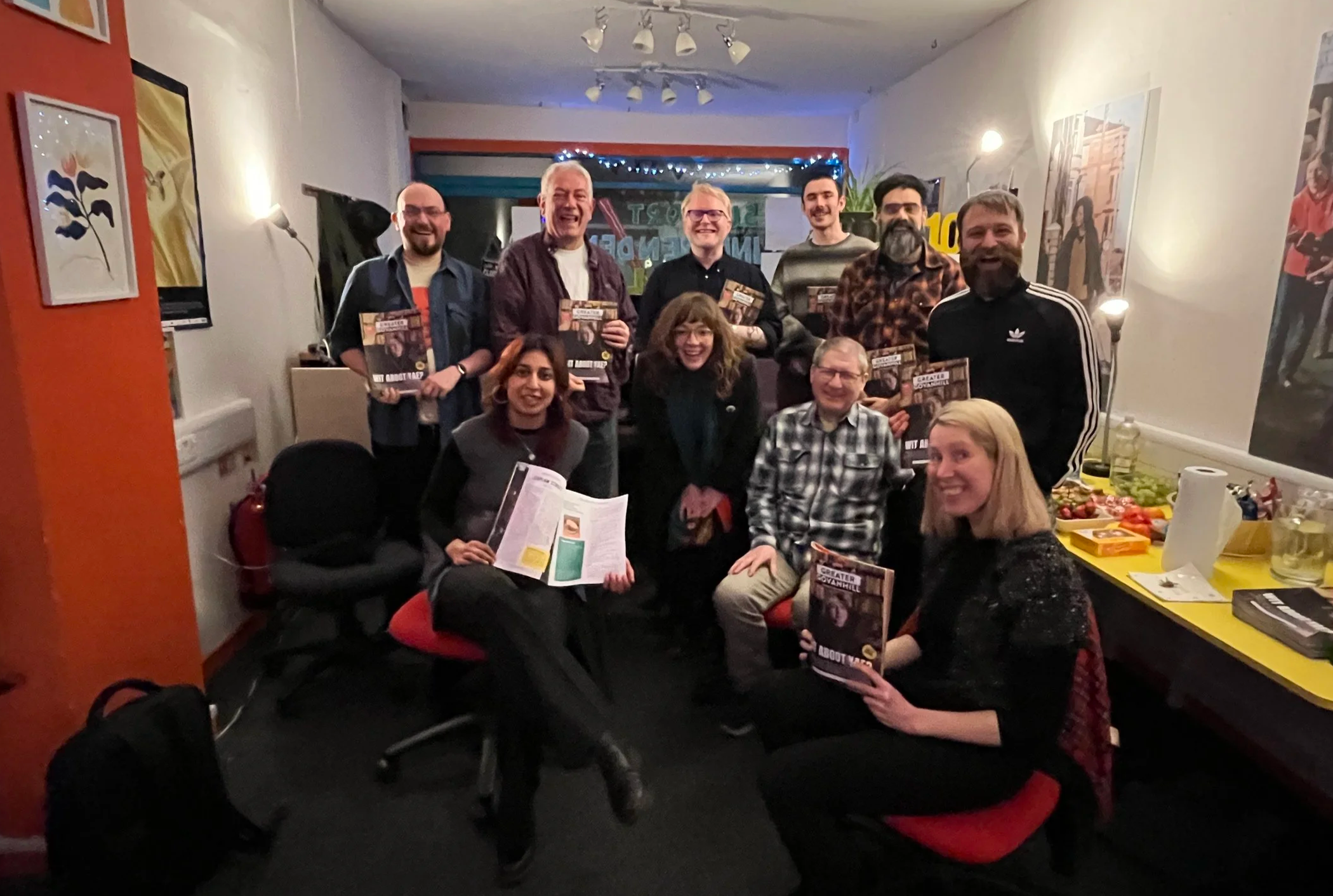
The launch night brought together contributors of the mag
Led by me, we spent a lot of time honing into exactly how each of us talk; the differences in our speech, influences on our dialect from places we’ve been, and the words we use and hear around Govanhill everyday which helped us to build the Govanhill Glosser in the magazine.
With 13 of us typically in the room, or online, our conversations always led us back to one key theme – identity. Although we knew as Scots – old and new – that we were Scottish and did speak Scots in some form or the other, it was unclear what the definition of a Scots speaker actually was. So, we decided (and I think this is true to most Scots) that if you are someone who uses Scots, no matter how wee or how broad, and no matter if you weren’t brought up speaking Scots or if you speak it with a different accent to me, or to Andrew, or to Samar, then you are a Scots speaker.
What came from that were three core truths we kept coming back to and discussing each week:
Identity is fluid: Being Scottish isn't just about a birth certificate; it’s about being part of a diverse community that is open, welcoming, and accepting.
The mastery of the code switch: Many group members revealed themselves as masters of the code switch, instinctively shifting their speed and vocabulary depending on their audience – something which is true for most people who speak multiple languages.
A language for everyone: Scots isn't a museum piece for the history books; it belongs to everyone here and now. In Govanhill, we see new Scots from Pakistan, Syria, and the Roma community picking up local patter and weaving it into their own mother tongues.
I think if you pick up this issue of the magazine, if you haven’t already, you will feel that replicated throughout the pages. From works of short fiction about a wizard finding his old spell book, to poems about speaking Scots/Urdu/English, and articles about the days Scots was actually taught in schools, the nuance of the Scottish language is something that just can’t be defined as one singular ‘thing’.
And with that, the response to the magazine has been lovely. From folk loving Wee Gerry Doll’s recipe, to chatting with people on the street who are finally seeing their ‘inner monologue’ reflected in print. It’s a magazine which shows the heart of Govanhill and the people living in it. We’re aw a wee bit different, we aw sound the way we sound, but at the end ae the day – we’re aw Scots.
By writing in our own authentic voices, we aren't just making a magazine; we are reclaiming a narrative that, like in my experience growing up and for so many others, has been getting systematically squeezed out of us for years. It’s about showing that you shouldn't be afraid to use the language that belongs to you and as one writer, Seán, said: “You need to embrace the fact that it’s a living, changing, moving language. It gives us all the chance to be a part of building it.”
Thank you to those who joined oor scrievin sessions and contributed to this special issue of Greater Govanhill Magazine:
Stacey Anderson, Alastair Callander, Andrew Conlin, Sean W. Pieper, Karmjit Badesha, Cat Cochrane, David Carr, David Doren, Zara Grew.
Here we!
If you are interested in joining our writing group, get in touch at newsroom@greatergovanhill.com. The group won't focus entirely on Scots, but will have sessions dedicated to this throughout. Instead, we will be co-leading the group with our members and looking at a wide range of topics, styles, and exercises.
