In conversation on writing, class, Scots and Agnes Owens
With the release of Agnes Owens’ ‘A Working Mother’ today, introduced by novelist Kirstin Innes, we’re looking back to our recent Scots issue and our conversation with Kirsten & artist Hayley-Janes Dawson we had in the joint Alistair Gray and Agnes Owens archives, surrounded by shelves of books, surrealist artwork and boxes upon boxes of notes, to chat about what an often overlooked literary great means to them.
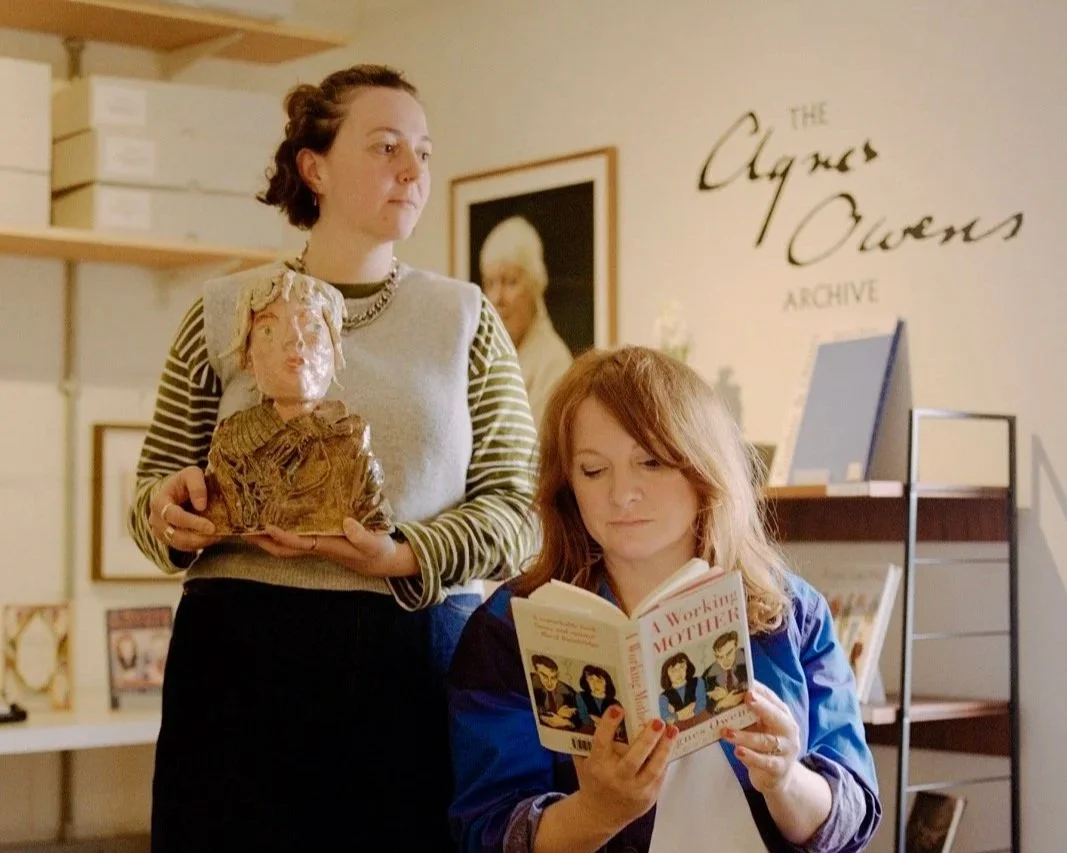
Interview by Rhiannon Davies | Photos by Miriam Ali
Kirsten Innes:
I’m a novelist and came to Agnes through studying Scottish literature at Aberdeen University. That was my introduction to Agnes because there was a professor there, Isobel Murray, who knew Agnes quite well. Agnes was still alive at the time. She was very much a champion for her work.
The writing that I do has always been influenced by that big boom in Scottish literature that happened in the nineties – where you’ve got James Kelman winning the Booker Prize and Trainspotting being published when I was around 13 and everyone at school was reading it. The movie came out when we were 16. It was like a different way of seeing Scottishness represented. In the nineties, it felt like there was this strange confidence and that’s what led me at the end of the century to study Scottish literature at university.
I immersed myself in the writing that was being published at the time. And obviously Agnes was being published in the eighties and nineties. That was where I came in. I do feel that movement influenced the way I write and the things I write about.
Hayley-Jane Dawson:
I’m a sometimes artist and sometimes writer. I don’t do it full time because I’m working class.
I was doing my master’s in Art Writing a couple of years ago when the Agnes Owens archive was starting up and our course leader shared an opportunity to help sort through the materials. I think I was one of the first people to get my hands on the stuff.
I studied sculpture as an undergraduate and then started writing post-graduation. I really enjoyed it and wanted to develop that alongside my sculpture practice, so I decided to do Art Writing. On the course I was doing a lot of writing in the first year. Then in the second year I went more back into the sculptural side.
I was writing a lot in Scots – in my Glaswegian dialect – writing about my family and my family’s history in the Govanhill area because my dad’s side of the family all grew up there three generations back. I was writing about my grandda and his life as a working-class person.
So I was really interested in this – unknown to me – working class writer. A lot of the writing I was doing was about the everyday and stuff that wasn’t really documented because everyday lives aren’t necessarily deemed important enough to document. For me, my family’s history is extremely important and interesting. So seeing someone writing about the everyday and not glossing over it – being very much like ‘life is tough and hard but there are moments of joy and niceness mixed in with that’, was a really refreshing thing to read.
K: When you said that about the everyday, what I’ve been looking at as writer in residence at the Agnes Ownes archives is how Agnes writes about herself – or actually doesn’t – and the absence of herself.
Yesterday I found a programme in the Alasdair Gray part of the archive for the 1984 Strathclyde Writers Festival. You’ve got all these writers giving their biographies and when it comes to Agnes, she’s got these four facts of biography that she repeats everywhere – that I find quite interesting.
She writes that she’s a fifty-seven-year-old mother of seven. She says when she was first married to her first husband she went off to the Highlands and toured around the Highlands for a year with her baby trying to find work. She has written that in a short story. I think that’s her only biographical short story that she published. She felt quite strange about including it – she really wanted to keep herself behind.
Everything else she glosses over. Until she says she has worked as a cleaner, she worked as a typist, and she was discovered by Alasdair Gray and Liz Lochhead. These are the facts she gives. She glosses over five other children being born, and her first husband dying. It’s almost like she looks for the extraordinary things about herself rather than the everyday and she doesn’t have the confidence, or maybe it’s because of privacy. But the everyday of her life, she keeps right back.
Apart from – you picked up on this in your zine about her work – this phrase “a hopeless case.”
HJ: Yes. That’s how I think she feels about herself. It’s such a shame she felt that way because when I read her writing, it struck a chord with me. I’ve been involved with the archive ever since and she’s clearly not a hopeless case. A lot of that is tangled up with working-class identity.
Most of the pieces in my zine were written in response to things I had read or researched in the archive. That phrase kept coming up.
K:It was a Latin teacher, I think at school, when she was 14 or 15. They were going round saying what they thought everyone would be. When they came to her they said: “You’re just a hopeless case.” That stuck with her. Those three words stuck with her. You go through the archive and you find it everywhere. She has not got rid of it.
The first short story she had published, which was in her thirties, was called A Hopeless Case. She’s done different versions of her biography called A Hopeless Case. You see different versions of that story in poem and prose. It’s always that moment of someone in power telling a child, or a powerless person, that they are a hopeless case. She was still writing versions of it into her eighties.
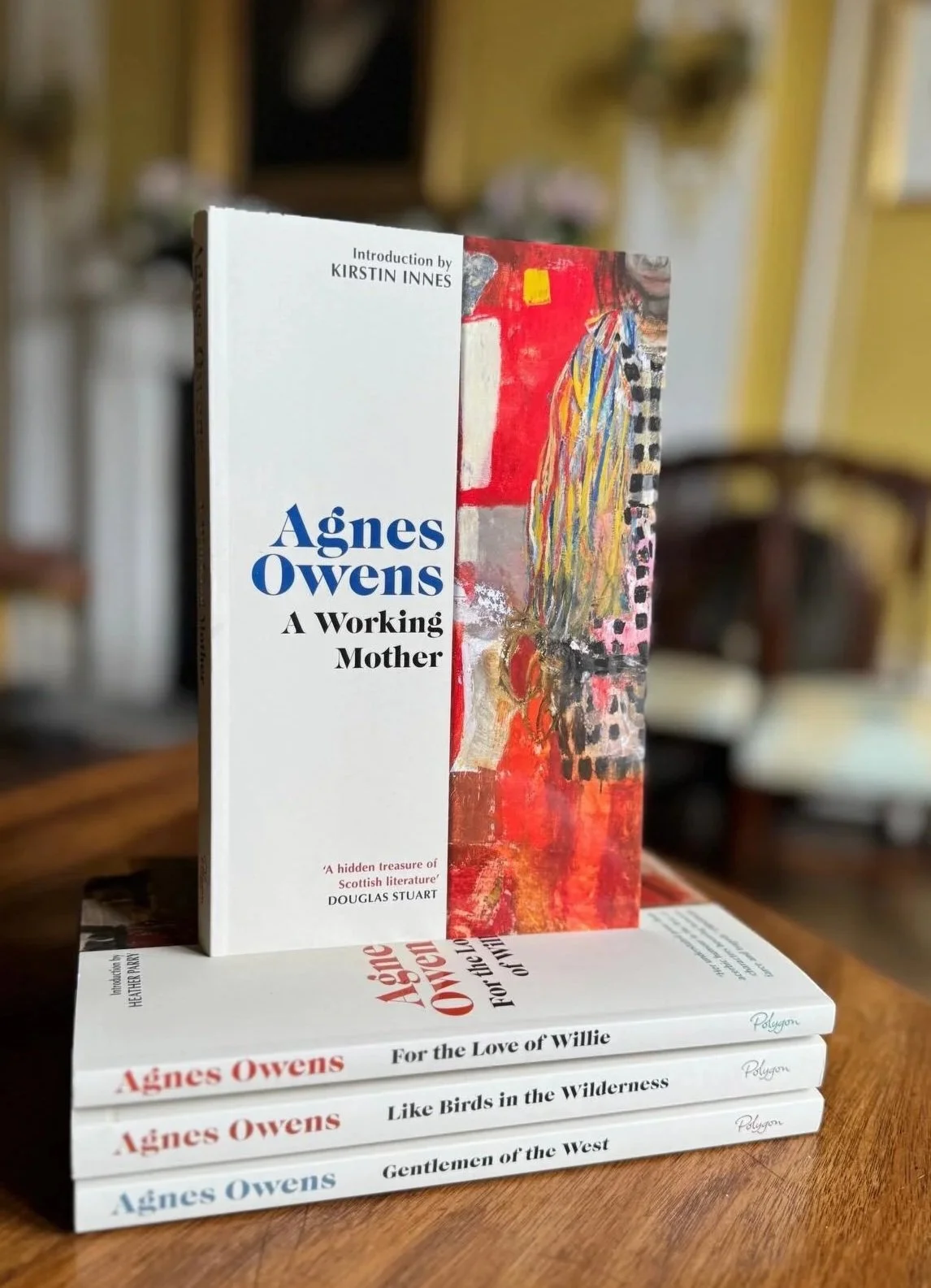
photo of the new edition by publisher BIRLINN via Instagram
H: Something like that never leaves you. Once someone has told you something like that, no matter what you do or achieve it’s still there in the back of your mind. That one person didn’t believe you could do it. I think that’s wrapped up in working-class identity.
No matter what happens, you still have this kind of imposter syndrome. I feel it myself. I’m sitting here doing this but I’m still saying ‘I’m not an artist, I’m a writer sometimes’. It never quite leaves you.
When I was studying my master’s, I had a really hard time being one of only two working-class people in the first year and then the only working-class person in the second year – feeling like I had to justify my writing and what I was doing and why I was talking about these things. Thinking ‘nobody wants to know about your grandda’s life as a printer’.
Even if, as happened with Agnes, Alasdair Gray tells you you’re an amazing writer, that doubt never goes away.
K: I’ve been tracking the points where she gets validation.
What’s so amazing about the archive is the way that she uses the typewriter. Her mother insisted she go and do a typing course and become a secretary as a means of social advancement. The typewriter represents work for her at first, and social mobility. Then it becomes the place where she writes.
She also seems to use the typewriter to think things through. When she’s preparing for interviews – I went into the Working Mother box and it’s an absolute gift for anybody who wants to write about it. There are three typed-out sheets where she tries different versions of the question: “I suppose you want to know why I wrote A Working Mother.” She gives three completely different answers. She’s just typed this out to try and use it as her thought process. And I found that so interesting. There’s something about that physical act, her fingers on the keys – that’s her getting into that different mindset. And that’s how she did it.
With validation – once James Kelman came to the class and she was writing some poems and stories about bricklayers because her son was a bricklayer. He said, ‘forget the poems and concentrate on the bricklayers’. That stuck with her and she repeats that in interviews. In Gentlemen of the West, which is the book that came out of that, you really see the James Kelman influence.
I also found a letter that I thought you’d find interesting. In the correspondence file there is a rejection of one of the stories from Gentlemen of the West. It comes with a short note that say something like: ‘Scotch dialect is difficult to sustain’.
H: I think I remember seeing that too.
K: Kelman was this mentor for her and was writing unapologetically in Scots. He’s also the same age as her kids. Have you heard that Tom Leonard thing where he talks about Scottish writers having their characters speak in Scots but the narrative is in English. He says ‘reader and writer are playing a little game and the game is that they are the same – and they are not the same as the f**king natives who do their dialect in phonetics”.
But for Agnes, there’s a difference in that as well. Because her characters – In Gentlemen of the West and Like Birds In The Wilderness, the characters speak Scots but in something like A Working Mother they don’t at all. And I wondered what you thought about that?
H: I go between both. In my writing I’ll go between writing fully in Scots – my version of Scots – and English. For my master’s thesis, I was still talking about being working class and being Scottish and those intertwined things, but I wrote that all in standard English.
The one time I wrote an essay fully in Scots, it was tough because I was trying to write it as I would say it. It’s not something we’ve ever really been taught. It’s different now with Scots being brought back into the fore a bit, but it’s not ingrained at all. It’s really difficult even for someone who wants to actively do it.
It’s less now than when Agnes was starting out but there is still that stigma attached to speaking and writing in Scots and that not being a proper way to speak. It can have its uses to have characters speaking in Scots, but the narration not. I do think there’s strengths in both approaches. There’s more of an appetite for Scots now. But still that stigma hasn't shifted enough.
K: I’ve been trying to experiment with my new book where the narrative voice is the voice of the land – specifically Renfrewshire land – and it’s the voice of the land that’s incredibly pissed off with humans. I was trying to make it sound like this sarcastic Scots-speaking auntie that’s also somehow a thousand-year-old entity. Just trying to use Scots in the narrative when it’s not dialogue – that idea of bringing Scots to a place where it can be the language that tells the story again, because we’ve all got that slight deference and step back, like if you’re telling the story, the story gets told in English.
With Agnes as well, she really resisted categorisation as a ‘female writer’. Sometimes she seemed resistant to the ‘Scottish writer’ label as well. She was often bracketed in with Kelman and Gray, almost as an afterthought. She was bracketed as a ‘Glasgow writer’, but she wasn’t a Glasgow writer. She’s not writing stories about Glasgow. She’s writing stories about smaller areas in the West Coast, that are not a major city – urban, rural, borderland kind of spaces, and the particular desperations of those lives.
I wonder if a lot of it was because she associated herself more with writers like Flannery O’Connor and John Steinbeck. She was going to the library all the time. Her son John Crosby says they never knew what she was reading because she didn’t have books in the house, but she was always getting them from the library for herself. Then they’d read an interview where she says, I love the work of John Steinbeck, and they were like, you never told us that. I wonder if it’s that articulation of a world that she recognised, and finding that way in between the two.
H: That was what was so important – I think our worlds are much more similar than mine and John Steinbeck’s – and that is what has drawn me so much to her work and has kept me there. I wish she was still alive so she could write more because it feels like there was so much more there still to come.
She’s writing as someone who grew up on that border. I lived in Kilsyth for a while as well as Glasgow. As someone who grew up in that kind of semi-rural urban area – with the issues and desperations and problems of that life, and then being in Glasgow and the different problems there. It really resonated with me. It felt like she was doing something that a lot of people weren’t, even though she didn’t necessarily bring in her personal life, you could feel where it came from.
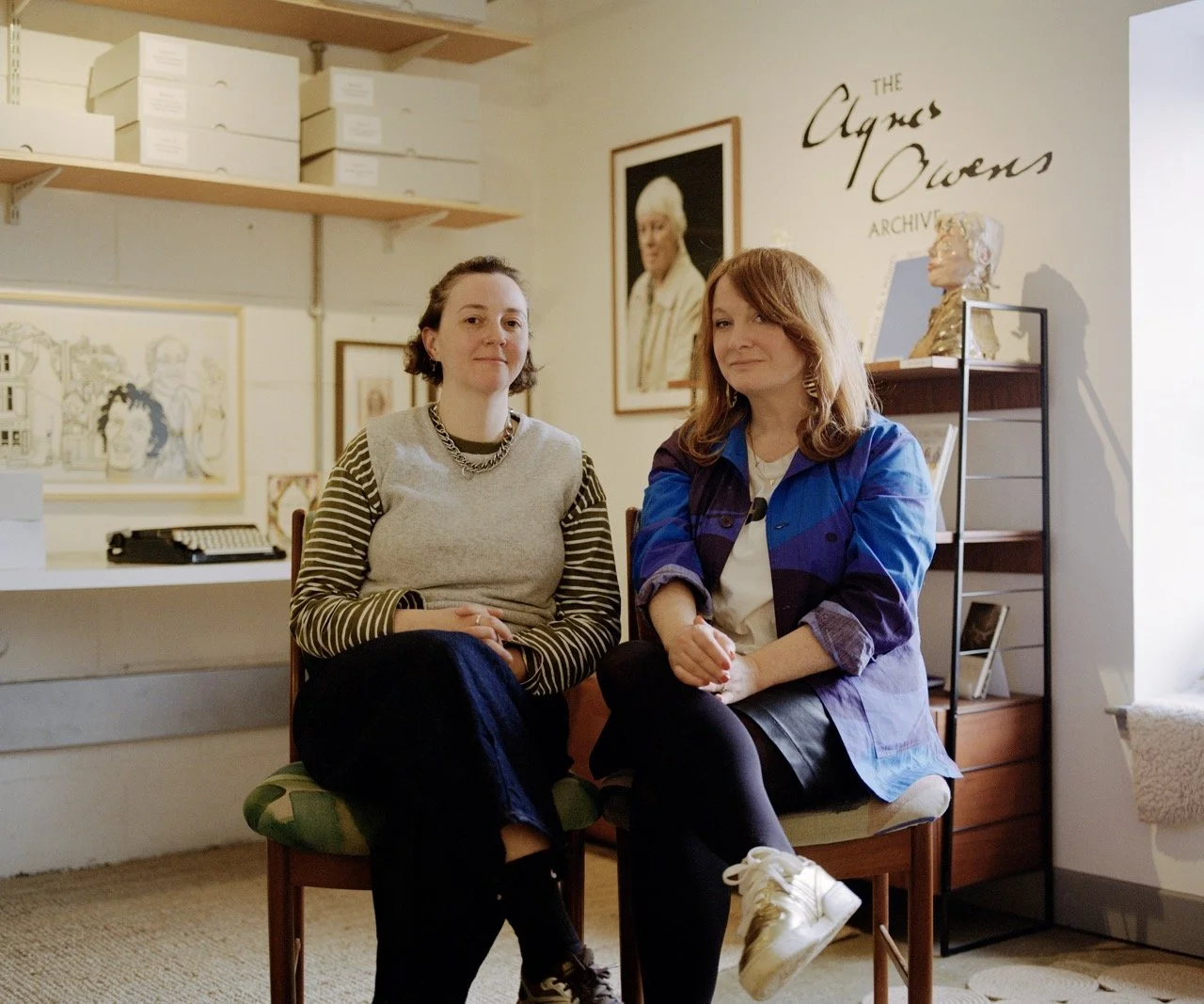
Hayley-Jane Dawson (left) Kirsten Innes (right)
K: Yeah there’s a great quote where she says something like ‘of course I have to write what I know – I don’t have the money to go off and research anything that isn’t the life that I see every day’.
H: I think that’s something that made me fall in love with her. It is relatable. When I did my master’s, we had an elective at Glasgow Uni and the homework we were given to read was people who died a hundred years ago who were writing stuff that was totally irrelevant to me and makes absolutely no odds to my everyday life.
And I think that’s why she’s coming to the fore again. Working class people don’t have as many opportunities as they did before, and they hardly had any before as it was. Now with the way that the world is, everything has become that much smaller, her writing takes you away a little bit and gives you a sense of adventure. Especially something like Birds in the Wilderness, where they go and live in the middle of nowhere.
K: At the end of Gentlemen of the West, you really feel the world closing in. There’s Mac, who is 22 and modelled in a way on her son who was a bricklayer. It’s just him and his mother. He’s not had any work as a bricklayer for a long time and he feels this small town village area closing in, so he goes north to try and get work on the oil rigs. Then you feel the world closing in again.
And that’s the subject matter – work. It always pisses me off when you read a book and the novelist hasn’t thought about what these characters do to bring money in. Where’s the money coming from? That refusal to acknowledge that work is a main part of the day.
In A Working Mother, you’ve got office work. In Gentlemen of the West, you’ve got the building site. Each thing is as important. Betty in A Working Mother moves between basically three environments for almost the whole book: her home with her alcoholic husband and the kids, the pub, and the office. And all three of those are given equal footing in the story. Writing about work and writing about drinking as well.
H: I’m always a bit wary when writing about working class everyday lives that it can become judgey or that there’s not much joy. But there’s also a strength in that honesty. The subjects she’s writing about are really important because they are the subjects that probably occupy most of a working person’s day as well. Working, drinking, problems, socialising, money.
I am working with Agnes Owens archive just now to create a set of ceramic objects based on objects within her books that then respond to themes that are predominant. They’re going to be part of the exhibition that’s happening in the Lillie Gallery in Milngavie in April, displayed in a sort of haphazard fashion on top of found objects, on the top of an upturned drawer, on random things, not on plinths. More of an installation of everyday life and the objects that Agnes puts importance on and that are important to a lot of people in working class daily life.
K: Polygon are republishing all of Agnes’ works over her centenary year and I’ve written a new introduction to A Working Mother, which is going to be one of the first. We’re launching those in Milngavie as well. I’m on a joint residency at the Alasdair Gray and Agnes Owen archives for the next eight months with the novelist Heather Parry, and I’m trying to come up with the beginnings of a short story collection inspired by what I find here and the connections between the two of them. Specifically at the moment, I’m looking at Agnes’s approaches to the way that she writes about motherhood and the way that she acknowledges the challenges.
If I was going to recommend one book to get people into her work, I would recommend People Like That. It’s her short story collection. It’s got the heart of her empathy. It’s not always a fun read. I would dip in and out. It’s a collection of vignettes of people really on the margins and you feel her ability to empathise with these people, not pity them, not sympathise, empathise, and treat them as equals.
H: I love A Working Mother. It’s a good enough chunk of a book that you can get into her writing and her style and her subject matters. The story leads itself along quite nicely so you’re not really having to have any prior knowledge. If you’re not working class or you’re not from that background, you can still get into it. It’s also where I keep, what we call in my family, ‘the float’ – my spare forty quid in case anything happens. I keep it in A Working Mother. So it’s my favourite book for many reasons.
K: There’s this whole thing that she never did anything until she got herself on a bus to the Vale of Leven and went to a creative writing workshop to get herself out of the house. That’s such a false narrative that she was carried along and allowed to be built around her in a way. But she wrote A Working Mother when she was in her thirties and it was called The Alcoholic. It sat in a box and she moved house with it a few times. She wrote it when she was in the relationship that inspired the book. The key to that book is that it bursts open the lie that she didn’t do anything until Liz Lochhead found her. She needed the confidence, the external validation to counteract the “hopeless case” that was always in the back of her head.
H But it was all already all there.
To celebrate her century year, Polygen is publishing new editions of Agnes Owens’ books with specially commissioned introductions from contemporary Scottish writers with four released this month – including A Working Mother, released today – and four more to be released in September this year. Further information can be found at: thealasdairgrayarchive.org/the-agnes-owens-archive
