‘It wasnae me’ – How the urban myth of a hurled pineapple became an award presented to the Glasgow Women’s Library
From an urban myth about a thrown pineapple to a solid silver trophy: Glasgow Women’s Library takes home a unique new award honouring the community groups powering local activism and transformation. We sat down with the artist, Nathan Coley, who designed the trophy, to find out more about the story that inspired him to create it.
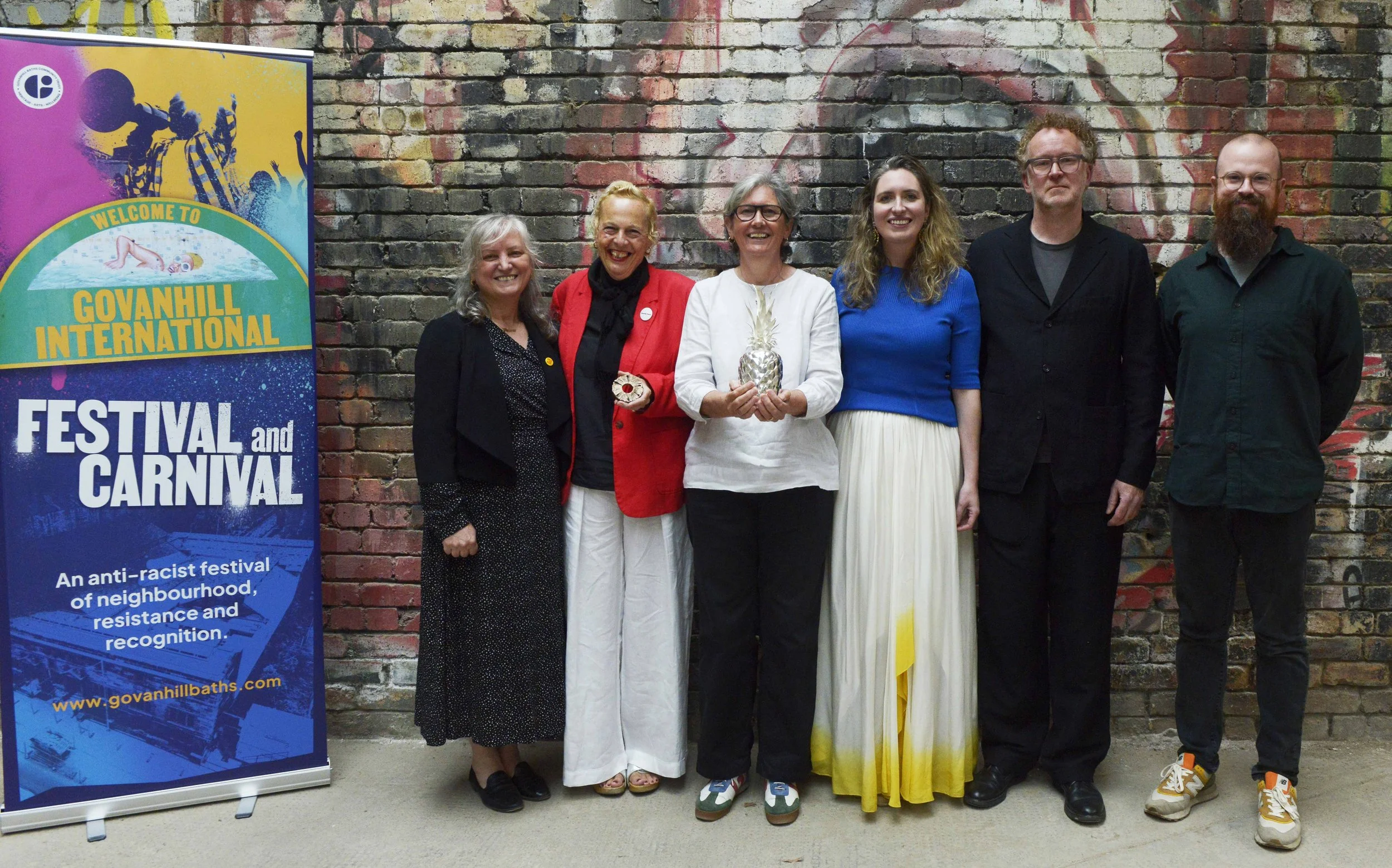
Adele Patrick and Sue John from the Women’s Library accepting the Pineapple Trophy award
By Rhiannon J Davies | Photos by Alan Dimmick
Glasgow Women’s Library has been named the first recipient of the Pineapple Trophy, the new community award created by artist Nathan Coley and Govanhill Baths Community Trust.
The award was presented at Govanhill Baths on 7 August, during a ceremony marking 25 years since the end of the 140-day occupation of the building.
Sue John, Co-Director of Glasgow Women’s Library, said: “We are overwhelmed and thrilled to have been chosen as the inaugural recipients of the Pineapple Trophy. Nathan Coley and Hamish Dobbie have, between them, conceived of and crafted a new civic artwork of beauty and significance.
“It is as poignant as it is full of wit, and speaks to the importance of community solidarity at a time when we have never needed it more.”
So how did a pineapple become an unusual new award? It begins with a story from the final day of the occupation of Govanhill Baths 25 years ago…
"When I tell the story to someone who doesn't know it, there's a degree of laughter and humour and cheekiness about it. But I think the fact that we've made it real changes things. We've made the story real because of the object, because of the sculpture. If I put the sculpture on your table, we would start a conversation."
Contemporary artist Nathan Coley is perhaps best known for his illuminated text installations making bold statements: We Must Cultivate Our Garden, There Will Be No Miracles Here and We Are The Monument. His work explores the relationship between communities and the places they inhabit. So when Govanhill Baths Community Trust approached him a few years ago about creating an artwork connected to the Baths, he wanted to make something rooted in the organisation's unique story.
“I started thinking very specifically about what they were as an organisation and what they've become, because I think those are two separate things. They were a baths and now they've become so much more than that. They've become much more of a support for the community… I wanted to find a way to make a work for them or about them, very specifically in relation to who they are, rather than it being a kind of classic Nathan Coley artwork."
What he created was a pineapple. Or rather, a trophy in the shape of a pineapple. Why a pineapple? Nathan explains:
"I came across a newspaper story about a policewoman who had been at the demonstration, on the day the police finally took back the Baths after the occupation. A year later she’d made a formal complaint and claimed she had been hit in the head with a pineapple that had been thrown from the other side of the line. There's no witnesses to this happening and none of the other police officers said it happened either, so her claim for one and a half million quid was thrown out and didn't come to anything.
“I kind of knew of the story because it had become an urban myth in the Southside. As great stories do, it grew arms and legs. People would talk about it as if they had been there when they hadn't. People would say, 'Yeah, I saw somebody throw it', when they didn't. Apparently someone made a T-shirt with a pineapple on it saying ‘it wasnae me’. I thought it was a fascinating story which, in a sense, encapsulates a whole lot of different competing ideas.
“So I started thinking about what the story of the pineapple actually was. Historians talk about the pineapple as being an imperial fruit. It was first grown and found in South America and wealthy Victorians craved it because they'd heard how delicious it was. Ships would try and bring it back to Europe but it would rot by the time it reached any wealthy dinner table. So it became this exotic symbol of wealth and sophistication."
"Bearing in mind Govanhill's make-up, with communities from elsewhere, I thought that was quite interesting. I also liked the idea that if a pineapple was thrown, it was simply because it was involved in that history. It was an illustration of the community in terms of what was around.
“I got to thinking that somehow the symbol of the pineapple, whether it was thrown or not – and more the object itself as a metaphor for something else – might be quite interesting to work with."
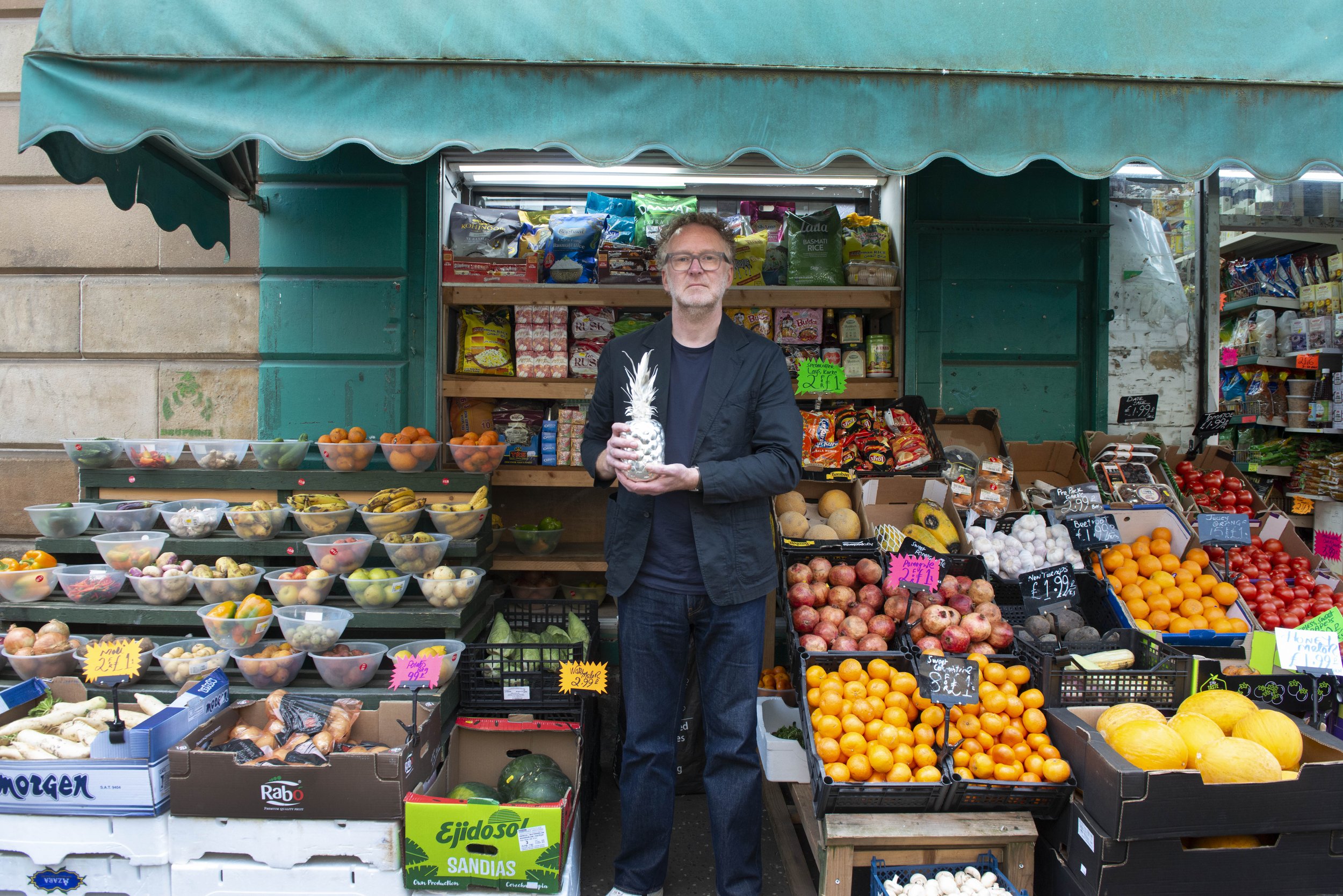
Nathan commissioned award-winning silversmith, Hamish Dobbie, to produce a silver life-sized pineapple that he describes as “quite bling, in a good way,” saying: “I very deliberately had it made so that it looks like it's Victorian. We haven't 3D scanned a pineapple and had it made in China. It's a stylised Victorian-looking piece of silver that would be in one of the cases in the Kelvingrove. It feels like it could've been made 100 years ago, which I think is beautiful 'cause that's when the Baths were made.”
But this is not just an artwork, intended to sit on display in a gallery. Instead it has a purpose.
Inspired by the swimming club trophies in the Govanhill Baths archive, each year the Pineapple Award will be given to a charity or organisation who is doing great things for the community. “I decided it might be interesting to find a way for the trophy, which is in the shape of a pineapple and refers to this act of resistance that happened 25 years ago, to somehow have a life and have a future."
For at least the next 20 years, the organisation who receives it will be presented with a solid bronze medal to keep – in the shape of a canned pineapple slice – all of which have already been produced and inscribed. Future recipients will help choose who receives the award next, creating a growing network of organisations connected through the Pineapple Award.
“And then after 20 years, there's this group of amazing organisations, and it kind of maps their existence as much as the Baths. That's the idea. But it doesn't have any history yet. It needs to grow.”