Bakeries, bike lanes and boarded up shops: Examining the evolution of Vicky Road
Victoria Road, one of Govanhill’s key arteries, has become a focal point in the debate around gentrification, local identity and community representation. But what does an explosion of coffee shops really mean? Joanne Krus examined how the high street has actually shifted
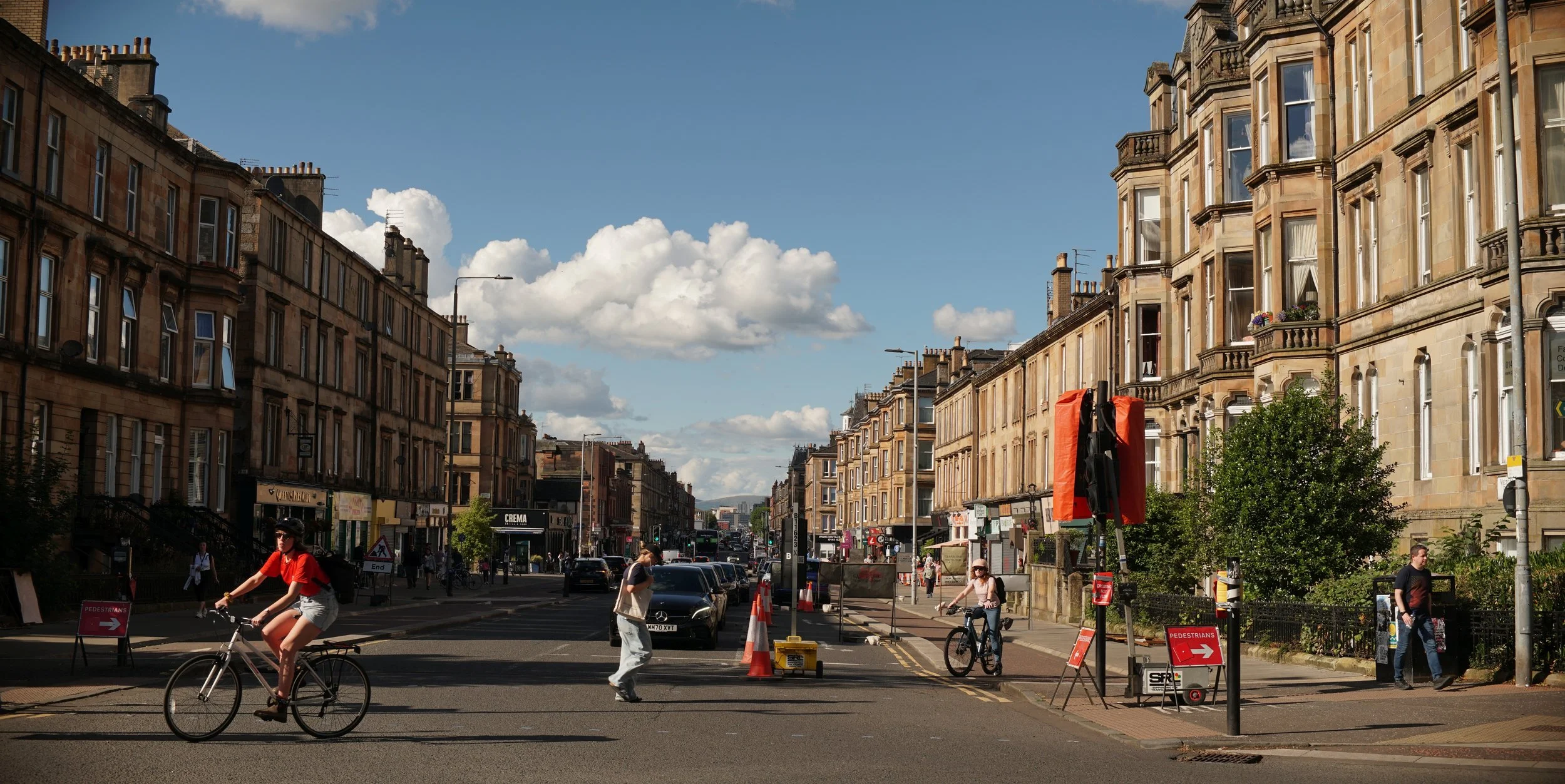
By Joanne Krus | Photo by Rob Reid
The changing perception and make-up of Govanhill has always been a contentious issue and, in many ways, the changing face of Vicky Road has become a byword of the gentrification of the area. But how much has really changed – and why?
While there will always be discussions on what constitutes gentrification, there is real concern that the shifting make-up of the high street comes with higher rents and less practical amenities. As one of Scotland's most diverse areas and one of the most disadvantaged (according to the Scottish Index of Multiple Deprivation), many have concerns about residents of Govanhill being left behind by the negative impacts of gentrification – namely, rising rents.
A street with deep roots
A 1912 guidebook described Victoria Road as ‘a cavalcade of emporia’. More than a century later, the description still (kind of) fits. According to a 2023 report by Glasgow City Council, the street acts as a ‘town centre’ and remains a key shopping corridor, lined with shops, offices and workshops. The report is part of the Liveable Neighbourhoods programme, which aims to help people meet their daily needs locally and sustainably.
In profiling Govanhill, the same report notes its population of 14,412 of which 4,428 are children and young people aged between 0-24 years, with roughly a third of the population from ethnic minority backgrounds. The report also notes high levels of overcrowded housing and low car ownership, meaning access to local services isn’t just nice to have – it’s essential.
So how do we track what’s happening?
There isn’t any record of the changing shops, so I set out to find out using the hi-tech approach of walking up and down the street with a pen and paper. I then did the same thing on Google Street View, which has been updating every couple of years since 2008. I selected 2008, 2015, 2020 and 2025 to create a dataset reflecting how the storefronts had changed over the years. While this is by no means a flawless dataset, the historical Street View provides valuable snapshots.
If you fancy a little nostalgic wander yourself, head to Google Street View, then select ‘See more dates’.
To keep the focus manageable, I studied the section from Kebabish Grill (323–325 Victoria Road) to Queen’s Park Cafe (530 Victoria Road). These two businesses, interestingly, haven’t changed since 2008. The Queen’s Park Cafe was established 1898; while Kebabish is a comparative newcomer, having been around since 2005.
Of the 120 storefronts I surveyed, just over a quarter (32) have remained unchanged in 17 years. The others are: Al-Khair Foundation, Anarkali, Bank of Scotland, Barnardo's, Boots, Callenders Beds, Campbell Sievewright estate agents, Campbell’s Boys’ Shop, Chalmer opticians, Chicken Cottage, Dental Scotland, FarmFoods, Greggs, Happy Days, Hot! tanning salon, Inex Home Hardware, Marie Curie, Mega Amusements, Michael Rodgers Hair, Patrick Campbell Solicitors, Ramsay's chippy, Ramsden's pawn shop, Ruthven Keenan Pollock & Co solicitors, Saj beauty salon, Subway, Sunshine Electrical, Victoria Bar, Victoria Road Carpets, Victoria Vault jewellers and William Hill.
What’s new – and what’s gone
Probably to no one's surprise, the biggest statistical shift has been the huge increase in restaurants, cafes, bakeries and other sweet treats. [Ed: Indeed, three new ones have opened since this research was undertaken!] In 2008, Greggs was the closest thing Vicky Road had to a bakery, but now people looking to satisfy a craving can pick from 10 bakeries and dessert shops. The number of restaurants, cafes and coffee shops has also risen from 13 in 2008 to 20 today.
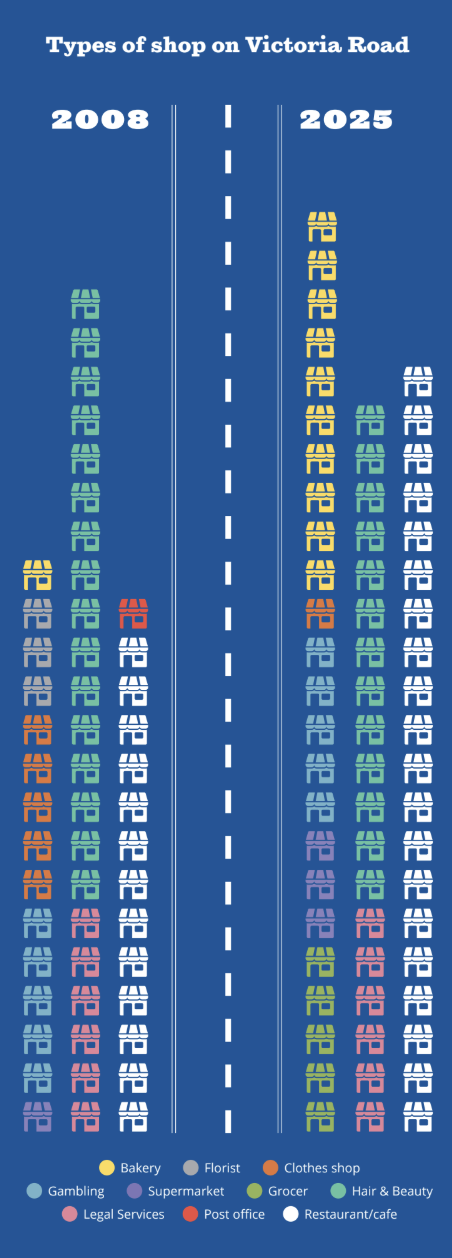
There are also five grocers now, when there were none in 2008. This may reflect the growth in small businesses catering to the different food cultures that make up the diverse Govanhill community.
The variety of shops has also decreased by 17 percent. Florists, greeting cards, travel agents and pet shops no longer exist at all on this stretch. Most of these businesses were gone before the pandemic, suggesting that Covid-19 has had little impact on the diversity of shops – even before any lockdowns, many people had switched to getting their flowers, cards at supermarkets or online
Many of the shops that have disappeared from the area sold household appliances and clothes. In 2015, there were five clothes shops, but today, the only clothes shop left is Campbell's Boys' Shop, selling children's uniforms. South Asian fabric shops were once more common, but now tend to be concentrated in the (more affordable) Cathcart Road or Allison Street.
Essential services have been more stable. Pharmacies, opticians, dentists and legal advisors have decreased slightly, but residents still have several options in each category, with several lasting the distance. Perhaps more concerning is the rise in vacant shops, with now over 10 percent of Vicky Road's storefronts sitting empty. This may be due to the increase in commercial rents, making high footfall lots unaffordable to many small businesses.
The planning picture
We also took a look at the data around planning permission in the area. Out of 118 planning application submissions related to commercial properties on Vicky Road between 2008–2025, nine proposals sought to convert shops into cafés (Class 1 to Class 3), and 31 applications involved digital signage, such as LED screens or illuminated advertising. The most common outcome overall was ‘approval with conditions’: 82 applications fell into this category, while only two were granted outright, and nine were withdrawn.
A total of 24 applications were refused – mostly concentrated in a few areas: 10 of the 24 refused applications related to digital signage, while 2 were café conversions, and 12 were other types, ranging from shopfront alterations to office reclassifications.
The stories behind the shopfronts
While some changes on Vicky Road reflect wider economic shifts – like the rise of online retail or the decline of specialist shops – others are more rooted in local planning, policy and investment. Whether these changes are symbols of gentrification or simply the evolution of cultural and consumer habits depends on who you ask.
Victoria Road, and its turnover of shops, tells a complex story – one of resilience and reinvention. As we continue to explore questions of ownership and power in Govanhill, the shopfronts of Vicky Road can present a visible index of who is served by these changes – and who gets left behind.
We have also begun work investigating ‘Who owns Govanhill?’, looking specifically at the concentration of ownership of commercial properties in the neighbourhood. If you have experiences – good or bad – of renting a commercial property in the neighbourhood, we’d love to hear from you. Please email newsroom@greatergovanhill.com with the title ‘Who owns Govanhill’ in the subject line.