Wit ye sayin aboot Scots?
Is it a language, a dialect, or a badge ae identity? Followin the Scottish Languages Act, we took tae Vicky Road tae talk "hurkle-durkling," Doric roots, and why Scots is aboot much mare than joost the wurds we use.
By Zara Grew
Did ye know that Scots is now an official language? In 2025 the Scottish Government introduced an Act recognising Scots and Gaelic as official languages of Scotland along wae English. But wit does it really mean tae speak Scots?
Some wid say it is a dialect, others a culture or class signifier. From Glaswegian tae Doric, Scots language is spoken everyday but wae no standardised Scots we wannae know wit does the Scots language mean to folk?
So one dreich Saturday, we headed doon tae Vicky Road tae see wit the people ae Govanhill think. We started off by asking folk if they have a favourite Scots word.
Responses included baw, naw, wee, ken, mingin, hurkle-durkling and Baltic.” An the standoot favourite from the afternoon? Outwith.
These are just a few of the Scots wurds people love tae hear and use. But when asked about whither or no they speak Scots or if they see Scots as a language we got a mixed bag of responses, proving that Scots means somehing different tae everyone.
A group of pals walked by us when we were ootside Short Long Black. One of the lassies, Sophie spoke tae us about Scots being linked tae cultural identity:
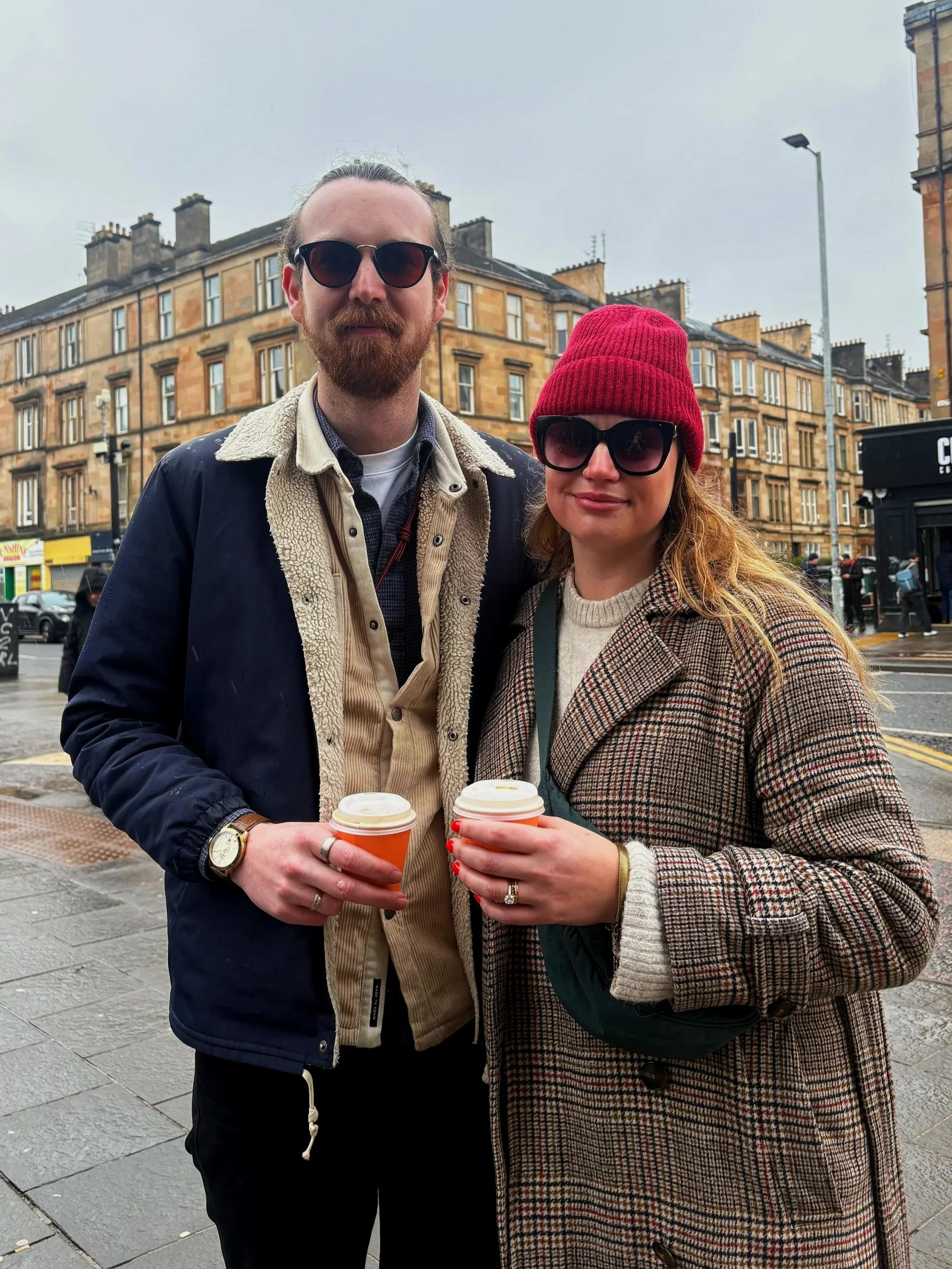
Graeme & Rachel
“A think it's important because it's a local identity. A think it's a good way to relate with people or to form that connection. Because if you say some of these wurds abroad, and if you've got another Scottish person around, you think ‘aw you're definitely from Glasgow’. So it's kinda nice to have that connection.”
A young Polish lad spoke tae us aboot his experience ae Scots an how it had been a bit of a hurdle for him: “I think it's it's fun but for me, it was sort of an obstacle because going to Scotland and speaking English, I thought my English was good but Scottish-English is not the same at all.”
“I think it's the most difficult when you go to the pub with your Scottish friends, and they're loud and they're saying words you don't know.”
Another passerby, Isabel fae Aberdeen, talked aboot her experience growing up an hearin Doric being spoken:
“I was surrounded by Doric growing up. I think Scots is something you don't actually realise is a different sort of language. My mum’s English, so during the census, I remember we had to tick ‘can you understand Scots? Read and speak Scots?’ And my mum was like, ‘Absolutely not,’ but we were all like, ‘of course we can’.”
Polina and Sofiia, both fae Ukraine spoke tae us aboot their experience of language an how that relates to Scots. Sofiia said:
“Language should be protected. It represents the identity of Scotland. And I think, as someone who comes from Ukraine, we have this very important aspect of language in our country because half of the country speaks Russian, and Russia is trying to enforce language on us. After the war started, I took a conscious choice to speak Ukrainian. So I feel like the same goes for Scotland. And I feel like it's very important that language doesn't go away”.
Rachel and Graeme walked past, coffees in hand, an they chatted tae us aboot the different perceptions ae Scots. Rachel said:
“With someone who speaks – as we describe it, broad Scots or slang – there's an assumption about their social class or their background. But maybe that's a city thing because if you were to travel much further up north the use of Scots is much more widespread, and it's not indicative of that at all. I think it's great. I think more people should be speaking languages and dialects that are representative of their culture.”
The publisher acknowledges receipt of the Scottish Government’s Scots Language Publication Grant towards this publication.
